Italy offers several tax incentives designed to attract retirees, entrepreneurs, high-net-worth individuals and remote workers. These regimes can be extremely generous — but they are complex and often conditional. This guide explains the main options in 2026, who qualifies, and how we can help you plan a compliant move.
Why Italy Offers Tax Incentives
Italy wants to attract investment, fresh talent and long-term residents to boost local economies — especially outside major cities. Tax incentives are tools to encourage relocation, entrepreneurship and pensioner migration to Italy’s regions.
Major Incentive Programmes (Overview)
1. Flat-Tax for New Residents (Art. 24-bis)
What it is: a substitute flat tax on foreign-source income. As of 2026, a common benchmark is €200,000/year for the principal applicant (with additional rules for family members).
• Who it’s for: high-net-worth individuals moving their tax residence to Italy.
• Duration: typically up to 15 years (elective regime; check local rules).
• Note: the rate and requirements have changed in recent years and further increases have been proposed for future applicants — plan accordingly.
2. Impatriate / Rientro dei Cervelli Regime
What it is: a favourable tax regime for skilled workers, executives and freelancers who relocate to Italy for work. In many cases a portion (e.g., 50%) of employment or self-employment income is exempt from Italian tax for a limited period.
• Who it’s for: qualifying employees or self-employed professionals who weren’t tax residents recently in Italy.
• Typical benefit: partial exemption on income (often 50%, rising in specific family/region cases).
• Term: often 5 years with possible extensions under certain conditions.
3. 7% Flat Tax for Foreign Pensioners in Small Southern Towns
What it is: a highly attractive 7% tax on foreign-source pension income for up to 10 years if you move to qualifying municipalities (usually under 20,000 residents) in specified southern regions.
• Who it’s for: foreign pensioners who commit to living in qualifying small towns.
• Why it matters: extremely low tax rate compared with many countries.
Key Requirements & How to Qualify
Although each scheme has its own rules, there are common requirements you must meet:
• Tax residence in Italy: typically >183 days in Italy per year, or registration with the anagrafe (resident registry) and proof the centre of your life is in Italy.
• Non-residence condition: many regimes require you were not tax resident in Italy for a certain number of previous years.
• Stable income: documented passive income or eligible employment income, depending on the regime.
• Accommodation: proof of housing in Italy (rental contract or deed) and genuine intention to reside.
• Insurance & compliance: private health insurance where required; timely tax filings and residency maintenance.
• Heads up: Consulates and local tax offices (agenzia delle entrate) sometimes apply discretion and local interpretation. That’s why preparing strong documentation matters.
What’s Changing — Policy Watch (2026)
Italian tax incentives have evolved quickly. Recent developments to watch:
• The flat-tax for new residents has been raised in recent years (previously €100k → €200k), and proposals to raise it further have been discussed in draft budgets. Changes may affect future applicants.
• Regional add-ons and special municipal incentives (to attract residents to small towns) can appear and disappear — timing is important.
• Law and regulations are updated frequently; always verify rules for the year you plan to move.
How We Help — Our Services
At Expats in Italy / Expats Living in Rome we support clients through the full planning and relocation process:
• Consultation to review your profile, income sources and relocation goals.
• Strategy call (30–60 mins) to design the timeline, choose the right regime and list documents required.
• Document collection & review: we help you gather proof of non-residence, income, accommodation and identify gaps.
• Introductions to trusted commercialisti & notaries: implementation partners who handle tax filings, elections and notarial needs.
• On-the-ground support: assistance with anagrafe registration, health insurance options, opening an Italian bank account and residency procedures.
Is a Tax Incentive Right for You?
Ask yourself:
• Is most of my income foreign-sourced (pension, rents, dividends, investments)?
• Can I realistically spend most of the year in Italy and establish residency?
• Have I been non-resident in Italy for the required look-back period?
• Am I prepared to engage with Italian tax and legal advisors for compliance?
• If you answered yes to several of the above, it’s worth exploring — but planning is essential.
Further Reading & Sources
Disclaimer: This post provides general information and is not legal or tax advice. Rules change frequently. Consult a qualified tax advisor or lawyer before making decisions. Contact us and speak to an expert in relocation today!

Find and Buy Your Ideal Property in Italy (2026)
Finding and Buying Property Investment in Italy Buying a property in Italy can be a complex and daunting process, especially for foreigners who are not familiar with the legal and bureaucratic aspects. That’s why we are here to help you every step of the way, from finding the property to signing the deed of purchase. […]

Executive Overseas Moving and Relocation Services with 1Relocation Worldwide
Global Moving Advocates: Introducing 1RELO Navigating International Relocation Logistics with Absolute Precision Relocating across international borders is a monumental lifestyle milestone, yet the physical reality of transitioning assets across continents presents an incredibly complex logistical puzzle. From navigating intricate maritime freight systems to clearing rigid port-of-entry customs checks, the operational burden requires professional, dedicated oversight. […]

How to Save on Taxes When Buying Your First Home in Italy
Buying a first home in Italy comes with significant tax benefits and incentives designed to make property ownership more accessible. Whether you are an Italian national or a foreigner, understanding these advantages can translate into substantial savings on your property purchase. The “Prima Casa” regime is essentially a set of tax reliefs applicable to the […]
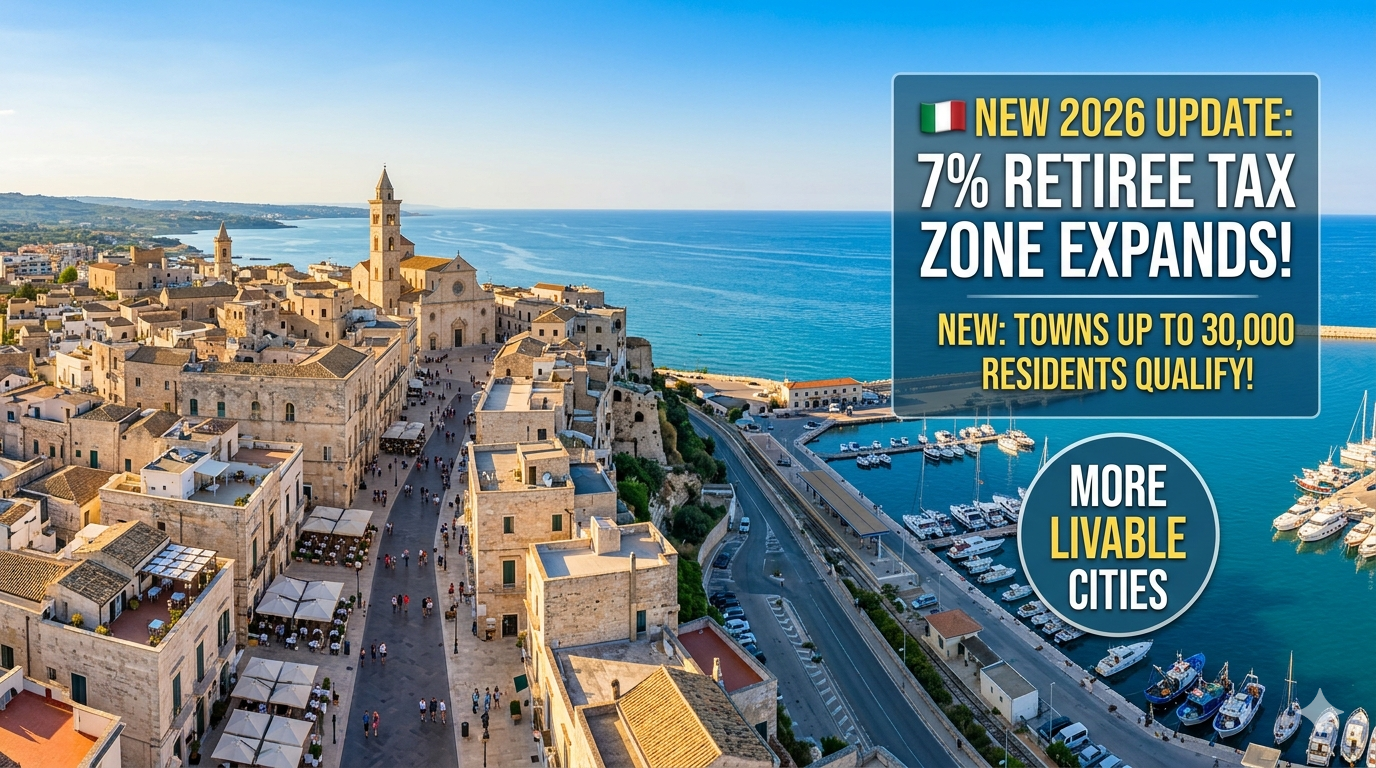
Italy Expands 7% Flat Tax: 74 New Towns Added in 2026
Big news for Italian retirement: You no longer have to live in a tiny village to save 93% on taxes. As of April 7, 2026, the Italian government officially raised the population threshold for the famous 7% tax regime. Previously limited to villages under 20,000 people, the limit has jumped to 30,000 residents. 🏥 Better […]
The answers to the top questions expats have concerning Italian taxation system.
1. After I move my tax residence in Italy how will I be taxed? After you will move your tax residence in Italy your taxation will be based on the world wide principle. This means that you will be taxed in Italy for the entire income that you earn worldwide. Non-Italian income will be taxed also in another country, you may have a tax credit with the convention against double taxation. To be sure where your income will be taxed you should consult a professional and explain your situation.
2. Can I work in Italy without to moving my tax residence there? Of course you can! In this case you need to know;
• Where your income will be taxed;
• Which kind of job you will do in Italy;
• Type of income that you get in Italy according with the Italian and international income classification;
• How long you will work in Italy;
• If the entity that pay your income has the tax residence in Italy, or has a permanent establishment in Italy;
• The country where you have your tax residence to verify if exists a convention against double taxation with Italy.
With this information it will be possibile to verify where you have to pay the taxes for Italian income.
3. How I will be taxed if I work in Italy without moving my tax residence there? Usually you will be taxed only for the income that you get in Italy. Anyway it is necessary to verify you personal situation (see the question number two for the information needed for to check your situation).
4. I own an apartment in Italy, but my tax residence is not in Italy. The apartment is not rented. Do I have to pay taxes on the apartment in Italy, even if I don’t get any income? Of course you will pay taxes in Italy. The taxes due are Municipal taxed, and are calculated on the cadastral value.
5. I have an apartment in Italy, and it is rented. Do I have to present the tax declaration and pay taxes in Italy? Yes, in this case you will need to present the tax declaration in Italy and you will need to pay the municipal taxes and also the IRPEF taxes (personal taxes).
6. I’m a student and I will work in Italy for an Internship. Do I have to pay taxes on my grant? It depends. Generally also the internship income are taxed in Italy. The only cases that allow you not to pay taxes in Italy on you internship grant are:
• In case the grant is not paid by an Italian resident;
• In case there is a specific exemption from the Italian tax rules, as is the case for the European Erasmus program.
7. In which cases does employment earned in Italy is not taxed in Italy? In case I don’t have the Italian tax residence? If you don’t have Italian tax residence and you receive income from employment in Italy, in case the country where you have your tax residence has stipulated a convention against double taxation with Italy, you will not taxed in Italy if:
(a) the recipient is present in Italy for a period or periods not exceeding 183 days in the considered fiscal year;
and
(b) the remuneration is paid by, or on behalf of, an employer who is not a resident in Italy;
and
(c) the remuneration is not paid by a permanent establishment or fixed base with employer in Italy.
In this case you will be taxed only in the country where you have your tax residence.
Looking for more help? Schedule a FREE 30 minute call with our finical advisor at [email protected] our team can help you understand and guide you with this.