Navigating Italy’s immigration system in 2026 requires more than just a dream; it requires a precise understanding of a sharp legal distinction between the right to enter and the right to remain. This process is intentionally complex and strictly bureaucratic. To succeed, you must follow a rigid sequence of events that begins long before you set foot on the Italian peninsula.
Visas are the primary gatekeepers. They are issued exclusively by Italian Embassies or Consular Sections in your country of residence before travel begins. It is a critical and common legal misconception that one can “upgrade” a tourist status to a long-term residency status once inside the country. If you wish to reside in Italy legally, you must apply for the correct visa category from your home country.
As of April 10, 2026, the new EU Entry/Exit System (EES) has changed the game for non-EU travelers. This digital system records facial images and fingerprints upon every entry and exit. Your precise time-in-country is now digitally tracked and instantly auditable by authorities across the Schengen Area. Ensuring your long-term paperwork is filed correctly has never been more vital.
The Golden Rule: The 8-Day DeadlineOnce you arrive in Italy with a long-term visa, you have exactly 8 working days (excluding Sundays and holidays) to apply for your Permesso di Soggiorno (Residence Permit).
This application is typically initiated at a Post Office with a “Sportello Amico” desk. Upon filing, you will receive a registered mail receipt. Keep this receipt! In the eyes of the law, this paper acts as your temporary legal permit until your plastic card is ready. Without it, you are technically undocumented. |
Common Long-Term Visa Categories
Italy offers several specialized pathways. Each has its own rigorous documentation requirements and financial thresholds for 2026.
Digital Nomad & Remote Worker VisaNow a staple of Italian immigration, this is for highly skilled professionals working for non-Italian employers or clients. It is exempt from annual quotas (Decreto Flussi), making it the most flexible work visa.
2026 Requirements: Proof of annual income of at least €28,000, health insurance, and evidence of “highly qualified” status (Degree or 3+ years experience). Check eligibility here. |
Elective Residency (Retirement)For those moving to Italy with significant passive income (pensions, investments, or royalties). You are strictly prohibited from working in any capacity, including remote work.
Minimum Income: €31,160 for singles or €37,392 for couples. You must also prove ownership or a long-term lease of a suitable residence. Full income breakdown here. |
The Investor Visa (“Golden Visa”)A fast-track route with no annual quotas. It grants a 2-year permit which is renewable for 3 years. You don’t need to live in Italy 183 days a year to keep it, making it ideal for business owners with global interests.
Minimum Investments: €250,000 in innovative startups, €500,000 in limited companies, or €2 million in government bonds. |
The Hidden Path: Education, Research & Youth Exchange
Many people overlook these categories, but they are vital for students, academics, and young travelers.
1. Student Visas (Studio)Required for any course exceeding 90 days. You must be enrolled in at least 20 hours of study per week. One major benefit in 2026 is that a study permit allows you to work part-time (up to 20 hours per week). Note that you must prove you have at least €50 per day for the duration of your stay. 2. Scientific Research VisaFor PhD holders or high-level scholars invited by an accredited Italian research institution. This permit allows for Intra-EU mobility, meaning you can conduct research in other EU states temporarily. It also features a simplified family reunification process. 3. Youth Mobility (Working Holiday)Italy has bilateral agreements with countries like Canada, Australia, and New Zealand. If you are aged 18-35, you can apply for a 12-month visa that allows you to travel |
If you’re considering a move to Italy, it’s important to seek legal advice to ensure a smooth transition. At Expat Living In Rome, we specialize in helping expats navigate the complexities of Italian law and bureaucracy. Our team of experienced lawyers can assist you with obtaining a residence permit, finding a job, and settling into your new life in Italy.

Use code WRTY10082 for 10% off
Thinking of Buying Instead?

Previously, Legal help for Expats published this post on how to acquire Italian citizenship. If you’ve read it and realized that CITIZENSHIP AS A RESULT OF ITALIAN PARENTS/ANCESTORS (“ius sanguinis”) is your case, then here are the complete instruction on how to proceed:
The procedure to apply for jure sanguinis citizenship can be carried out at the Italian Consulate in a foreign country where the applicant resides, or in Italy.
(Art. 1, Law No. 91/1992)
If the citizenship application process is filed in Italy, you might need to move to Italy for the duration of the procedure (in order to be available in case public administration requires it; you can process it or delegate the process)
Immediately after your arrival in Italy, you must declare your presence in the country (“dichiarazione di presenza”) at the Municipality where the procedure will be carried out indicating your residence address. Then you must appear in person before the “Prefettura” with appointment to get your paperwork checked.
Duration of citizenship recognition under administrative law is not predictable at all, since 2018 the Italian Government has established that Public Administration has 4 years to decide on said requests.
The procedure
To apply for jure sanguinis citizenship the applicant must show that he/she has an Italian ascendant and that the citizenship chain has not been interrupted or lost.
You must gather all the required documentation: birth, marriage and death certificates of all ascendants in the same line of kinship up to the applicant applying for citizenship; certificate stating “the absence of loss of Italian citizenship” by the Italian ascendant (e.g.: a letter from a State Public Department such as an Electoral Office or the National Naturalization Record stating that the ascendant never acquired citizenship in any other Country to which he/she emigrated, i.e. and did not lose or renounce Italian citizenship.
The Electoral Office shall certify, that the person never appeared on voting list). Otherwise, if the Italian ascendant has lost or renounce citizenship their Italian citizenship, the applicant must present certificates showing that citizenship was lost after the descendant’s birth, who has acquired the right to citizenship and continues with the citizenship chain.
Example of the right chain of transmission:
- marriage of ascendant A with B
- birth of ascendant C (son of A + B)
- death of ascendant A
- marriage of ascendant C with D
- birth of ascendant E (son of C + D)
- death of ascendant C
- marriage of ascendant E with F
- etc. ... following the chain up to the applicant for citizenship (you)
Each descendant must have been born before the death of his or her direct ascendant.
It does not matter if at any point in his/her life that ascendant A (only Italian citizen of the chain) has lost citizenship, what does matter is that his/her child (C) was born before they lost their citizenship of A.
All certificates issued by foreign Authorities must be legalized and translated by a sworn translator. Legalization is an administrative procedure by which validity is granted to a foreign official document, verifying the authenticity of the signature and the capacity of the signing authority (e.g.: in the case of the UK, USA, Spain or Argentina a document is legalized by apostille). This means that certificates must be legalized only in case they are issued by Official Organizations.
A common question is “does the Apostille expire?”
The Apostille does not have an expiration date, and valid as long as the document is still valid. Birth, marriage or death certificates issued in Argentina and in Italy that are legalized, authorized and apostilled have no expiration date; certificates issued in Spain are valid for three months. Therefore, we suggest that you check with the registry of your own country, or even better, in the city or town where the citizenship process is carried out to avoid expired documentation. Which can delay your process.
Old certificates often present many errors (typos, names do not match, birth dates are not correct, etc.). As a result, doubts could arise about the identity of the person in question. In such cases you can request the corresponding Official Department to rectify the document or to issue a certificate stating that the identity of one person indicated in two different documents is the same.
The “1948” case
In the case of jure sanguinis citizenship by female ascendant, when one of the ascendants is a woman and her descendant was born before 1948, a trial must be initiated before the court with jurisdiction in Rome in order to carry out the necessary procedures.
In common language this is known as the “1948” case.
In 1948 the Italian Constitution established the principle of equal rights between men and women. As there are still legal gaps in some areas of the Italian legal system (including citizenship), a judge’s ruling is necessary for the Court to recognize citizenship.
The duration of the trial can last from 1 to 3 years.
A power of attorney is required to start the trial
In order to avoid any dispute that may delay and/or block a trial, when the applicant can’t sign the power of attorney in person before the lawyer in Italy, we recommend the issuance of a public deed. However, power to act can be granted by private instrument certified by a notary public. In this second case, as established by the Italian Supreme Court of Appeals (rulings nº 22559 of November 4, 2015; nº 12309 of May 25, 2007; n. Of May 5, 2006, etc.), the following is essential:
1) the power of attorney must be signed in the presence of a notary public;
2) the Notary public must have verified the identity of the parties;
3) points 1) and 2) must arise from the declaration of the notary public attached to the deed.
Minors must be represented by the child’s parent or legal guardian. You should check with the notary public in your country which formalities must be fulfilled in such a case.
FAQ:
– When in the same family line there are several descendants interested in obtaining citizenship, one single process (parental trial) can be initiated. Legal representation shall be collective and simultaneous and, as a result, costs shall be reduced.
– The procedure can be followed using the smartphone app “Giustizia Civile”. The app allows checking all the ever-changing circumstances of the trial – except for the name of the parties and the lawyer due to privacy reasons.
– According to Italian law, a child under 18 years old who has already acquired citizenship automatically acquires citizenship if he/she lives permanently with the parent who has already acquired citizenship, even outside Italy (art. 14 law n. 91 / 1992). Proof of cohabitation must be presented together with the necessary documentation (for example, residence certificates).
Subscribe to our newsletter to access content and updates to help navigate life as an expat in Italy. If you need help with your citizenship process, language courses, or general expat life in Italy, email us at [email protected].
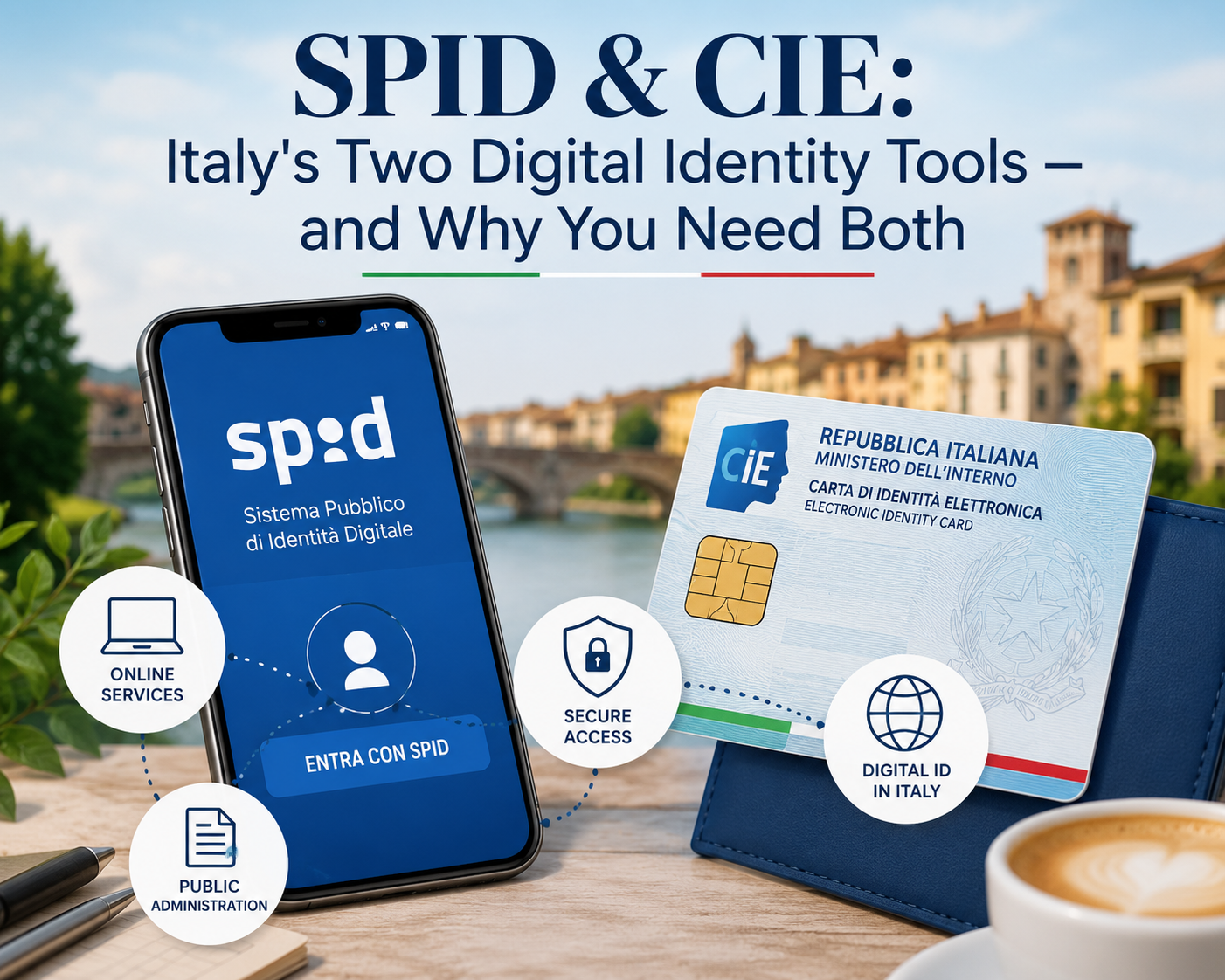
SPID & CIE: Italy’s Two Digital Identity Tools — and Why You Need Both
If you’re living in Italy, SPID and CIE aren’t optional extras — they’re how you access nearly every government service, from booking your Questura appointment to filing taxes online. Here’s how to get both. CIE — Carta d’Identità Elettronica Your Italian electronic ID card, issued by your local Comune. It’s also a digital key […]

Rental Deposit Italy: How to Get Your Money Back
How to Get Your Rental Deposit Back in Italy Protect your caparra before you even unpack — practical, legally sound advice for expats renting in Italy. Securing your rental deposit Italy return is one of the biggest worries for expats. One of the most common questions we hear is, “How can I make sure I […]

What’s On in Italy July 2026: Best Festivals & Events
From legendary bareback horse races to starlit open-air operas, discover the absolute best cultural festivals taking over the peninsula this month. July in Italy is a spectacular explosion of culture, music, and open-air celebrations. As the summer heat settles over the beautiful Mediterranean landscape, the country’s historic piazzas, ancient amphitheaters, and coastal waters transform into […]

Riding Through History: Vespa Turns 80 in the Heart of the Eternal City
From a post-war dream to a global symbol of freedom and style, Vespa is gearing up for the biggest party in its history. Vespa changed the world of urban mobility forever when an intuition on two wheels came to life eight decades ago. On April 23, 1946, Piaggio filed the patent for a “practical nature” […]

My New Life in Abruzzo: A Journey of Reinvention and Belonging
Benvenuti! Welcome to My Italian Adventure Hi, I’m Tim König, and this is the story of how my husband Giulio and I bid farewell to our familiar life in the United States to begin a vibrant new chapter in Abruzzo, Italia. What started as a late-night dream shared over coffee eventually blossomed into a full-scale […]

Find and Buy Your Ideal Property in Italy (2026)
Finding and Buying Property Investment in Italy Buying a property in Italy can be a complex and daunting process, especially for foreigners who are not familiar with the legal and bureaucratic aspects. That’s why we are here to help you every step of the way, from finding the property to signing the deed of purchase. […]

What’s On in Italy in June 2026
Festivals, Culture, Food & Summer Events June is one of the most exciting months to be in Italy. The days are long, the evenings are warm, and cities, towns, beaches, piazzas, parks, museums, and historic villas come alive with festivals, concerts, food events, outdoor cinema, and national celebrations. Whether you live in Italy, are […]

Executive Overseas Moving and Relocation Services with 1Relocation Worldwide
Global Moving Advocates: Introducing 1RELO Navigating International Relocation Logistics with Absolute Precision Relocating across international borders is a monumental lifestyle milestone, yet the physical reality of transitioning assets across continents presents an incredibly complex logistical puzzle. From navigating intricate maritime freight systems to clearing rigid port-of-entry customs checks, the operational burden requires professional, dedicated oversight. […]
If you are a not an Italian speaker and you are about to sign an Italian contract we offer this advice.
You should get the contract translated into your own language or into a language you can fully understand. Prevention is better than cure.
We strongly recommend you to contact your lawyer BEFORE signing any contract and BEFORE making any payment. This is the only way to fully understand the consequences of the contractual relationship you are about to enter and to protect your interests through the inclusion of other conditional clauses.
Regarding rental contracts, for example, it is strongly recommended to register the lease (NB the registration is necessary only for rentals up to 30 days). Under the Italian Law system a non-registered contract is invalid, it doesn’t exist.
Registration of the lease is not only an obligation established by law, it is also a guarantee for those who rent an apartment. In case of non registration, the tenant can’t establish the residency in the apartment, the landlord cannot sue the tenant who refuses to pay the monthly price and the tenant can sue the landlord to get the amount back (but this is not an easy procedure). There are also serious fiscal consequences for the landlord and tenant in case of non-registration. It’s also recommended to make payments by bank transfer and not in cash.
#RomeExpats Team
SPID & CIE: Italy’s Two Digital Identity Tools — and Why You Need Both
If you’re living in Italy, SPID and CIE aren’t optional extras — they’re how you access nearly every government service, from booking your Questura appointment to filing taxes online. Here’s how to get both. CIE — Carta d’Identità Elettronica Your Italian electronic ID card, issued by your local Comune. It’s also a digital key […]
Rental Deposit Italy: How to Get Your Money Back
How to Get Your Rental Deposit Back in Italy Protect your caparra before you even unpack — practical, legally sound advice for expats renting in Italy. Securing your rental deposit Italy return is one of the biggest worries for expats. One of the most common questions we hear is, “How can I make sure I […]
What’s On in Italy July 2026: Best Festivals & Events
From legendary bareback horse races to starlit open-air operas, discover the absolute best cultural festivals taking over the peninsula this month. July in Italy is a spectacular explosion of culture, music, and open-air celebrations. As the summer heat settles over the beautiful Mediterranean landscape, the country’s historic piazzas, ancient amphitheaters, and coastal waters transform into […]
Riding Through History: Vespa Turns 80 in the Heart of the Eternal City
From a post-war dream to a global symbol of freedom and style, Vespa is gearing up for the biggest party in its history. Vespa changed the world of urban mobility forever when an intuition on two wheels came to life eight decades ago. On April 23, 1946, Piaggio filed the patent for a “practical nature” […]
My New Life in Abruzzo: A Journey of Reinvention and Belonging
Benvenuti! Welcome to My Italian Adventure Hi, I’m Tim König, and this is the story of how my husband Giulio and I bid farewell to our familiar life in the United States to begin a vibrant new chapter in Abruzzo, Italia. What started as a late-night dream shared over coffee eventually blossomed into a full-scale […]
Find and Buy Your Ideal Property in Italy (2026)
Finding and Buying Property Investment in Italy Buying a property in Italy can be a complex and daunting process, especially for foreigners who are not familiar with the legal and bureaucratic aspects. That’s why we are here to help you every step of the way, from finding the property to signing the deed of purchase. […]
What’s On in Italy in June 2026
Festivals, Culture, Food & Summer Events June is one of the most exciting months to be in Italy. The days are long, the evenings are warm, and cities, towns, beaches, piazzas, parks, museums, and historic villas come alive with festivals, concerts, food events, outdoor cinema, and national celebrations. Whether you live in Italy, are […]
Executive Overseas Moving and Relocation Services with 1Relocation Worldwide
Global Moving Advocates: Introducing 1RELO Navigating International Relocation Logistics with Absolute Precision Relocating across international borders is a monumental lifestyle milestone, yet the physical reality of transitioning assets across continents presents an incredibly complex logistical puzzle. From navigating intricate maritime freight systems to clearing rigid port-of-entry customs checks, the operational burden requires professional, dedicated oversight. […]

Is Italian Citizenship Worth It? Benefits of an Italian Passport in 2026
Is Italian Citizenship Still Worth It in 2026? Benefits, New Rules, and What You Need to Know Italian citizenship has long been one of the most sought-after citizenships in the world. For decades, millions of people with Italian ancestry have explored the possibility of reclaiming their heritage while gaining access to the many opportunities that […]

How to Move to Italy: A Step-by-Step Guide 2026
Comprehensive 2026 Residency Roadmap If you are considering relocating to Italy in 2026, you are likely drawn to the unparalleled lifestyle, the history, and the vibrant culture. However, moving to Italy is more than just booking a flight; it is a legal journey that requires navigating a complex bureaucratic system. There are several distinct pathways […]

How to Become a Self-Employed Worker in Italy 2026
A practical guide for non-EU citizens who want to live in Italy, work independently, open a business, freelance, consult, or build a professional life abroad. Need help with your move to Italy? Becoming self-employed in Italy can be exciting, but the process can also feel confusing, especially if you are trying to understand visas, permits, […]

What’s On in Italy: May 2026 Edition
Your Monthly Guide to Culture, Festivals, and Living La Dolce Vita May is arguably the most beautiful month to be in Italy. Across the peninsula, May 2026 is marked by a return to outdoor living, floral festivals, and the start of the major cultural season. Whether you are a resident or planning a property scouting […]
Travel Insurance for Expats in Italy: Why AURAS Might Be the Flexible Solution You’ve Been Looking For
Living in Italy is a dream — but figuring out the right insurance coverage? That’s another story. If you’ve spent any time navigating the expat life in Italy, you know that one of the most persistent headaches is finding travel and health insurance that actually fits your situation. You’re not a typical tourist. You’re […]

How to Save on Taxes When Buying Your First Home in Italy
Buying a first home in Italy comes with significant tax benefits and incentives designed to make property ownership more accessible. Whether you are an Italian national or a foreigner, understanding these advantages can translate into substantial savings on your property purchase. The “Prima Casa” regime is essentially a set of tax reliefs applicable to the […]
Elective Residency Visa Italy 2026: Tips and Requirements
Live in Italy without working and enjoy the Italian lifestyle with long term residency. Live in Italy Without Working The Elective Residency Visa for Italy is a long term visa designed for non EU citizens who wish to live in Italy without working or running a business. In 2026, this visa remains one of the […]

Exploring Italy’s Stunning Beaches by Train: A Guide for Expats
Italy’s coastline is a paradise for beach lovers, offering a variety of beautiful beaches accessible by train. For expats living in Italy, the convenience of train travel opens up a world of coastal adventures without the need for a car. Here’s a guide to some of the most spectacular Italian beaches you can easily reach […]
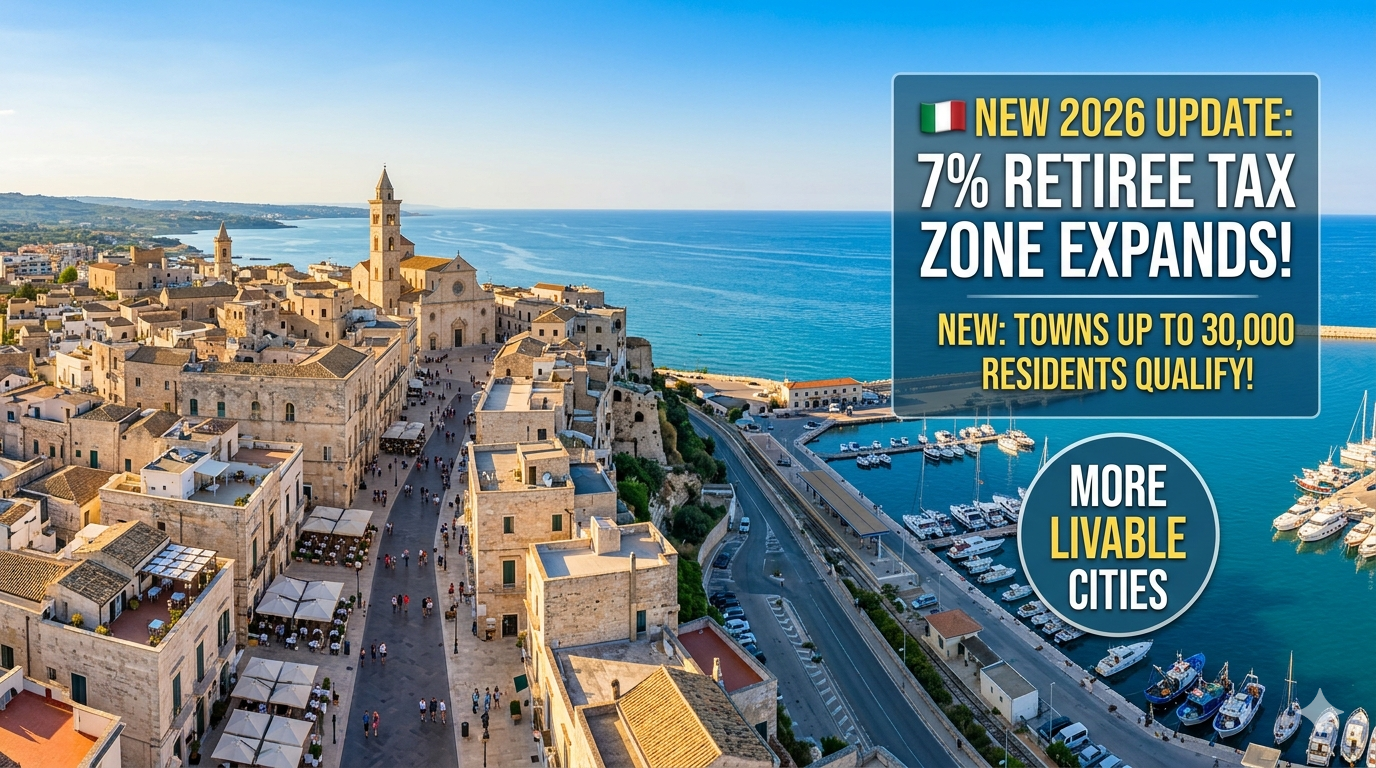
Italy Expands 7% Flat Tax: 74 New Towns Added in 2026
Big news for Italian retirement: You no longer have to live in a tiny village to save 93% on taxes. As of April 7, 2026, the Italian government officially raised the population threshold for the famous 7% tax regime. Previously limited to villages under 20,000 people, the limit has jumped to 30,000 residents. 🏥 Better […]

The 2026 Guide to the Italian Digital Nomad Visa: Requirements & Realities
After years of anticipation, Italy’s Digital Nomad Visa is officially in full swing. This visa is a game-changer for non-EU citizens who want to trade their home office for a sun-drenched balcony in Rome or a villa in Tuscany. However, because it is a relatively new category, there is still a lot of confusion regarding […]

Understanding Salaries in Italy: A Guide for Expats and Newcomers
A practical guide to Italian salaries, net pay, regional differences, cost of living, job expectations, and how Expats Living in Rome can help you plan your move with more confidence. Moving to Italy for work? Salary is only one part of the picture. For many expats, Italy offers a dream lifestyle: beautiful cities, historic neighborhoods, […]

Buying Property in Italy: Why You Need a Strategic Consultant
Buying Property in Italy: 4-Phase Strategic Purchase Plan A comprehensive framework for expats and investors to navigate the Italian real estate market with professional precision. Do you dream of a farmhouse in Tuscany, a luxury villa on Lake Como, or a seaside home in Puglia? Whether you are looking for an investment apartment in Rome […]

Tips & Tricks for Residency, Healthcare, and Surviving Italian Bureaucracy
Confusion with Italian Bureaucracy: How Things Will Not Change… But You Will! If you’ve ever tried to navigate Italian bureaucracy as an expat, you probably know the feeling: confusion, frustration, and the sense that everything moves in circles. Forms lead to other forms. Offices send you to other offices. And sometimes the information you’re given […]

Easter Monday in Italy: “Ghost Egg Hunt” in Celleno, Hundreds Expected
A unique initiative comes from Celleno, Italy (province of Viterbo), a small village about 90 minutes from Rome: the “Ghost Egg Hunt”, which will take place on Easter Monday (April 6, 2026) in the area’s well-known “ghost town” in the Tuscia region of central Italy. Between 200 and 400 visitors are expected in Celleno, Italy, taking part in the […]

What’s On in Italy: April 2026 Edition
April in Italy is the “sweet spot”—the wisteria is blooming, the crowds haven’t fully peaked, and the calendar is packed. Here are the must-know events for your community. 1. Pasqua & Pasquetta (Easter Weekend) Dates: April 5 (Easter Sunday) & April 6 (Easter Monday) The Vibe: Pure tradition. Rome will be very busy with the […]

Long & Short Term Rental Assistance in Italy
Book a 15-minute Free Call Today! Securing a rental property in Italy requires deep knowledge of local laws and fluency in Italian. These are often the biggest hurdles for internationals moving to Italy. Our specialized rental assistance service provides the expertise you need to secure your ideal home with confidence and legal security. With our […]

Tax Residency Incentives in Italy — Your Guide 2026
Italy offers several tax incentives designed to attract retirees, entrepreneurs, high-net-worth individuals and remote workers. These regimes can be extremely generous — but they are complex and often conditional. This guide explains the main options in 2026, who qualifies, and how we can help you plan a compliant move. Why Italy Offers Tax Incentives Italy […]

Easter in Italy 2026: What to See, Eat, and Celebrate.
Easter, or “Pasqua,” is one of the most significant and beautiful times to be in Italy. In 2026, Easter Sunday falls on April 5th, bringing with it a week of profound religious traditions, vibrant spring festivals, and, of course, incredible seasonal food. Whether you are a religious pilgrim, a history enthusiast, or an expat looking […]

Things to Do in Italy in Spring 2026
Spring in Italy is a magical time. The weather is warm but not too hot, the flowers are in full bloom, and the cities come alive with festivals, outdoor activities, and cultural events. For expats living in Italy, it’s the perfect time to explore the country’s diverse landscapes and vibrant culture. Here’s a breakdown of […]

What You Need to Know About Visas and Permits to Stay in Italy
Navigating Italy’s immigration system in 2026 requires more than just a dream; it requires a precise understanding of a sharp legal distinction between the right to enter and the right to remain. This process is intentionally complex and strictly bureaucratic. To succeed, you must follow a rigid sequence of events that begins long before you […]

What’s on in Italy: March 2026 | Events in Italy You Won’t Want to Miss!
What’s On in Italy: March 2026 Events Expats Will Love Posted on March 2, 2026 March in Italy is a month of vivid transformation. As the winter chill recedes, the peninsula bursts into life with spring festivals, high-energy sporting events, and significant cultural anniversaries. Whether you are looking for historic re-enactments, world-class rugby, or the […]

Single Female Travelers in Italy: Practical, Confident, and Connected
Italy rewards curiosity and courage. For the woman traveling solo, the peninsula offers a unique blend of safety, community, and liberation. Far from the clichés of Eat Pray Love, modern Italy is a place where independence is celebrated, and a solo journey often becomes a personal renaissance. This guide offers grounded tips, cultural insights, and […]

How to Register in Italy as an EU Citizen
If you are an EU citizen planning to live in Italy permanently, one of the most important things you will need to do is register your residence with the local municipality, known in Italian as the Comune. This process is called iscrizione anagrafica, or residence registration. It confirms that you officially live in Italy […]

Bringing Your Family to Italy: A Guide for Non-EU Citizens
For non-EU citizens residing in Italy, having your family with you is a tangible goal. Italian law provides a framework for family reunification, allowing you to bring close relatives to live with you under specific conditions. This guide outlines the key requirements, procedures, and rights to help you navigate the process. Who Can Apply for […]

What’s On in Italy: January 2026 Events Expats Will Love
January in Italy may be quieter than the summer months, but it’s packed with culture, tradition, fashion, and great opportunities to explore without the crowds. From iconic festivals and fashion weeks to free museum days and winter food experiences, here are 12 events happening across Italy in January 2026 that expats shouldn’t miss. 🔥 Fòcara […]

Buying or Leasing a Car in Italy as an Expat
A Practical Guide for Expats Living in Rome — Featuring Cars for Expats Moving to Italy is exhilarating—sun-soaked weekends, cobblestone streets, and the freedom to explore the country at your own pace. But sooner or later, every expat in Rome faces the same question: Should I buy or lease a car in Italy—and how do […]

The Year Italy’s Expat Landscape Shifted
Italy’s expat community experienced notable changes in 2025. While metropolitan hubs like Rome and Milan remain magnets for international residents, the most striking trend has been the surge of expats relocating to smaller Italian towns—many with populations under 20,000. For many, this shift reflects affordability concerns, evolving lifestyle priorities, and the changing policy environment around […]

How to Navigate the Property Search and Purchase Process in Italy
Looking to buy property in Italy? We are here to help you step by step! Have you always dreamed of owning a home in Italy—whether it’s a charming countryside farmhouse, a coastal villa, or a cozy apartment in a historic town? We’re here to help turn that dream into reality. Buying real estate in […]

Non-Married Partners: How to Obtain a Residence Permit in Italy as De Facto Cohabitants
In Italy, de facto cohabitants are two adults who live together in a stable relationship, are emotionally connected as a couple, and provide each other with mutual moral and material support. Recognized formally under the Legge Cirinnà (Law 76/2016), this framework protects couples who are not married, not in a civil union with someone else, […]

New Year’s Eve Free Concert 2026 in Rome at Circo Massimo
Rome is getting ready to welcome 2026 with an unforgettable night of music, energy, and spectacle. With the support of RDS 100% Grandi Successi, Roma Capitale has officially announced the highly anticipated New Year’s Eve Concert 2026, taking place on December 31st starting at 9:00 PM in the iconic setting of Circo Massimo, one of […]
What’s Quietly Changing in Italy (and What You Should Check)
Italy did not overhaul immigration overnight—but several updates have shifted how things work behind the scenes. Some affect people already living here, others impact those applying from abroad, and a few could catch you off guard if you rely on outdated advice. Nothing here is panic-worthy, but all of it is worth checking before a […]

Christmas in Italy 2025: A Magical Season for Expats Across Italy
Christmas in Italy isn’t just a holiday — it’s a season full of history, flavor, celebration, and heartfelt traditions that bring families, towns, and entire regions to life. Whether you’re an expat experiencing your first Italian Christmas or a returning fan of the magic, 2025 promises some beautiful celebrations across the country. Here’s what to […]
This article contains useful information for British citizens in Italy in the case of a no-deal Brexit)
EU legislation states that EU citizens have the right to reside on the territory of another EU country for up to three months without any conditions other than the requirement to hold a valid identity card or passport.
Once the UK decided to leave the EU, it has been established that English citizens who have been resident in Italy for less than three months can apply for legal residence (attestazione di residenza) by 31 st October and in case of a no-deal Brexit they will have the right to permanently stay in Italy as it was before the Brexit.
To apply for the residency by the Municipality of Rome you must fulfil the standard application form that you can find on the municipality website.
Basic requirements are as follow:
1) Evidence or affidavit the applicant have financial resources (about 5.500 euros per person – amounts vary year after year);
2) Health Insurance (minimum duration one year);
3) Copy of a valid Passport;
4) Accommodation: if you own the place where you live in Italy, you must attach a copy of the property title; otherwise, you must give evidence of a registered lease agreement or any other accommodation arrangement (for example, letter of hospitality by the landlord, a relative or a friend);
5) Marriage certificate (only if you are applying with your spouse, both being EU citizens);
6) Birth certificate (if you apply with your children)
7) Certificate of civil status evidencing you are single
Bare in mind that, if the Municipality won’t allow you to apply before 31 st October, it’s better if you keep any evidence that shows that you were in the country on 31 st October and intending to stay (not just a tourist visit): evidence of your request (email, “raccomandata con ricevuta di ritorno”, protocol number of the request, etc.), evidence of your arrival (flight tickets, passport stamp, etc.), evidence of your rental contract or property purchase or even hotel stay, Italian bank account showing payments in and out (for eg. utility bills if appropriate).


The 2003 European Directive on the status of non EU nationals states that a long-term residence permit should be awarded after a person has lived legally in an EU State for an uninterrupted period of five years.
This however depends upon the applicant having a stable and regular source of income, health insurance and (when required by the EU State), having complied with integration measures (he must also not constitute a threat to public security or public policy). If the applicant complies with these conditions, he can receive an EU long-term residence permit, renewable, without expiration and the status of EU long-term resident. The owner of a long-term residence permit receives the same treatment and rights as nationals in many areas: for example, access to employment and self-employment activity; social protection and assistance, move to another State of the Schengen area, etc.