Your Monthly Guide to Culture, Festivals, and Living La Dolce Vita
May is arguably the most beautiful month to be in Italy. Across the peninsula, May 2026 is marked by a return to outdoor living, floral festivals, and the start of the major cultural season. Whether you are a resident or planning a property scouting trip, these events offer the perfect backdrop to experience Italian life at its finest.
May in Italy is a symphony of colors and perfect weather. As the spring sun warms the piazzas from Milan to Palermo, the country wakes up with festivals, flower shows, and world-class sporting events. Here is what you cannot miss this month.
MAY 1 – Primo Maggio (Labor Day Concert)
Labor Day is a significant national holiday in Italy. While most offices and businesses close, the cities come alive with music. In Rome, the famous “Concertone” at Piazza San Giovanni is the place to be. It is a massive, free, day-long music festival featuring a mix of legendary Italian artists and rising stars. Pack a picnic, wear comfortable shoes, and join the local crowds for one of the biggest community events of the year.
Start the month with a cultural feast. All state-run museums offer free admission. While tickets are free, many popular sites like the Colosseum or the Uffizi still require a pre-booked entry slot to manage 2026 crowds.
The legendary cycling race traverses the peninsula this month. Watch for the “Maglia Rosa” (pink jersey) as the world’s best cyclists tackle Italy’s scenic coastal roads and brutal mountain passes. Even if you aren’t a cycling enthusiast, the atmosphere in the “tappa” (stage) towns is electric, with local food festivals and pink decorations everywhere you look.
Opening May 9 – The 61st Venice Biennale
The eyes of the world turn to Venice for the official opening of the International Art Exhibition. This transforms the entire city, with hundreds of events in the Giardini and Arsenale.
Located on the slopes of the Aventine Hill, this public garden opens for only a short window during the spring bloom. Home to over 1,000 varieties of roses, it offers a breathtaking view of the Palatine Hill. It is a quiet oasis in the middle of the city—perfect for a peaceful afternoon walk after a busy work week.
Mid-May – Infiorata di Noto (Sicily)
The town of Noto creates masterpieces out of flower petals on Via Nicolaci. This is a stunning display of Sicilian baroque culture.
During the Night of Museums, cultural sites across Italy open their doors until the early hours of the morning. For a symbolic entry fee of €1, you can explore world-class galleries, archeological sites, and hidden palazzos under the moonlight. Many venues also host special concerts, dance performances, and guided tours specifically for the occasion.
MAY 30 – 31, 2026 – Cantine Aperte (Open Cellars)
This is the highlight of the year for wine enthusiasts. Wineries across the country open their gates to the public for tastings and tours. It is an excellent way to explore the Italian countryside, meet local producers, and learn about the winemaking process. Many vineyards also organize special “vigneto” lunches and live music sets among the vines.
Network After Work: Rome
We are excited to host our next networking evening specifically for Rome’s international professionals and diplomatic community. This is a “no-speech” event designed for authentic connection over high-quality aperitivo. Meet FAO/UN staff, embassy members, and fellow expats in a sophisticated Roman setting.
Join our community for the venue reveal and RSVP link next week!
May is the peak season for property viewings. If you are looking to buy in 2026, we provide expert acquisition services to help you navigate the local market. Book a Property Consultation
Keep Your US Connection
Don’t lose access to your US bank. Use Tello to keep your number active for $5/month via eSIM. Get Your Tello $10 Credit Here
Enjoy May in Italy—the month where every corner of the country feels like a scene from a movie. Arrivederci!
If you’re considering a move to Italy, it’s important to seek legal advice to ensure a smooth transition. At Expat Living In Rome, we specialize in helping expats navigate the complexities of Italian law and bureaucracy. Our team of experienced lawyers can assist you with obtaining a residence permit, finding a job, and settling into your new life in Italy.
Living in Italy is a dream — but figuring out the right insurance coverage? That’s another story.
If you’ve spent any time navigating the expat life in Italy, you know that one of the most persistent headaches is finding travel and health insurance that actually fits your situation. You’re not a typical tourist. You’re not always a full-time resident either. You might be on a long-stay visa, a digital nomad permit, a student program, or simply stretching your time between countries. Standard insurance products were rarely designed with you in mind.
That’s exactly why AURAS has been gaining traction among international travelers and expats worldwide — and why it’s worth a closer look for anyone in the Italy expat community.
What Is AURAS?
AURAS is an online-based international travel insurance platform that lets you purchase coverage entirely digitally, in minutes, from anywhere in the world — including while you’re already abroad. It covers medical emergencies, hospitalization, emergency dental care, baggage loss, and more, with coverage limits ranging from $35,000 up to $1,000,000.
One thing that genuinely sets AURAS apart: you don’t have to be at home to sign up. If you’re already living in Italy and your current policy just expired, you can purchase AURAS coverage today and be protected within 48 hours.
The Flexibility Problem with Most Travel Insurance
Here’s the frustration many expats in Italy know well: most travel insurance providers operate on a subscription model. You pay monthly, automatically, whether you need it or not. This works fine if your situation is predictable. But for many people in the expat world — those who split time between countries, take extended trips, or have coverage from other sources for part of the year — a mandatory recurring subscription simply doesn’t match how they actually live.
AURAS takes a different approach. Rather than locking you into one model, it offers multiple plan structures to fit different needs:
• Fixed-term plans — choose a specific start and end date, pay once, done. Perfect if you need coverage for a defined trip or period. • Monthly subscription plans — auto-renewing month-to-month, ideal for ongoing nomadic life or open-ended stays. • Short-term one-day options — for a single high-activity day (skiing, ziplining, etc.) without changing your main policy.
This range of options means you’re not forced into a model that doesn’t suit you. You choose what you need, for as long as you need it.
Key Features Worth Knowing
Coverage starts fast. Purchase before you travel and coverage begins the next day. Already in Italy or traveling? Check the “Already Traveling” option at purchase, and your coverage activates 48 hours after payment.
Useful for visa applications. AURAS issues an official insurance certificate in English, which can be submitted as proof of coverage for various Italian and EU visa types — including long-stay permits that require documented health or travel insurance. Always verify specific requirements with the relevant consulate before applying.
Flexible coverage amounts. Choose from four tiers: $35,000 / $100,000 / $500,000 / $1,000,000. Your choice affects both the premium and the coverage limits for specific benefits.
Multiple plan types for different activities. Whether you spend your days doing yoga in the piazza (Calm plan), taking a weekend ski trip to the Dolomites (Extreme plan), going hiking in Umbria (Active plan), or studying at a Roman university (Study plan), there’s a category designed for your activity level. Choosing the right one matters — it directly affects what’s covered in the event of a claim.
14-day cancellation window. If you purchase a plan before it starts and change your mind, you can request a refund within 14 days. The official policy mentions a possible administrative fee, though in practice many users report receiving full refunds when canceling promptly.
A $100 deductible keeps premiums affordable. The standard plan includes a $100 per-claim deductible — meaning the first $100 of any medical claim is your responsibility, and AURAS covers the rest. This structure keeps costs low for the majority of travelers who complete their trips without needing to claim. If you prefer zero out-of-pocket costs at claim time, there’s an optional “No Deductible” add-on.
Optional Add-Ons
•AURAS offers a range of optional extras you can add at purchase (not after, so think ahead): •No Deductible — removes the $100 per-claim cost •Trip Cancellation — covers cancellation due to illness, family bereavement, severe weather, or legal obligations •Search & Rescue — helicopter evacuation and rescue team costs (essential for mountain or remote travel) •Premium Baggage Coverage — for lost or delayed luggage •Alcohol Coverage — medical expenses covered even if an incident occurs while drinking
Visa Cancellation — refund of consular fees if your visa application is denied.
What to Be Careful About
AURASis a genuinely useful product, but like any insurance, it works best when you understand it fully before you need it.
Report incidents within 48 hours. AURAS requires notification of any insured incident within 48 hours via chat or email. Exceptions apply for valid reasons (being at sea, in remote areas, without signal), but unexplained delays can complicate your claim.
Choose your plan type accurately. Activities classified as Active (surfing, trekking, ballroom dancing) are not covered under the Calm plan. Extreme activities (skiing, bungee jumping, ziplining) require the Extreme plan. Getting this wrong at purchase is the most common reason claims are denied.
Claims are handled with support. Depending on the situation, treatment may be paid directly to the medical provider or reimbursed to you after you submit the required documents. You don’t need to search for clinics or manage everything on your own — the AURAS assistance team is there to support you from the first call to full resolution. Where reimbursement applies, submit your receipts and documentation within 30 days; the average processing time is approximately 14 business days once all documents are received.
How to Purchase: A Quick Overview
The application takes about 3–5 minutes and is done entirely online at auras.insure.
Step 1 — Policy Details Select your destination (Worldwide is recommended for most expats), travel dates, coverage amount, and plan type. If you’re already in Italy, check the “Already Traveling” box.
Step 2 — Personal Information Enter your full name, date of birth, passport number, email, and phone number. Your insurance certificate PDF arrives at this email immediately after purchase.
Step 3 — Add-Ons Review optional extras and add what makes sense for your situation.
After purchase, you receive a PDF certificate with a QR code you can scan on your phone to view your full policy details anytime.
Is AURAS Right for You?
AURAS works well for expats and long-term travelers who:
• Need coverage while already living or traveling abroad • Want a defined-term policy rather than an open-ended subscription • Are between coverage periods (e.g., credit card insurance has expired, new employer health plan hasn’t kicked in) • Need an official insurance certificate for a visa application • Prefer to customize coverage rather than pay for a one-size-fits-all bundle
The Bottom Line
Finding insurance that actually fits the expat lifestyle has always required some creative thinking. What makes AURAS stand out isn’t just the price — it’s the fact that you’re not forced into a structure that doesn’t match how you live. Whether you need 10 days of coverage, three months, or an auto-renewing monthly plan, you can get what you need without paying for what you don’t.
For anyone in the Italy expat community navigating coverage gaps, visa applications, or simply looking for a flexible backup option — it’s worth taking a few minutes to get a quote.
Use promo code WRTY10082 at checkout for a discount on your policy.
As with any insurance product, always read the full policy document before purchasing and verify that the coverage meets the specific requirements of your visa or permit.
Live in Italy without working and enjoy the Italian lifestyle with long term residency.
Live in Italy Without Working
The Elective Residency Visa for Italy is a long term visa designed for non EU citizens who wish to live in Italy without working or running a business. In 2026, this visa remains one of the most popular pathways for retirees and financially independent individuals who earn income from pensions, investments, or savings.
Who Is the Elective Residency Visa For?
This visa is best suited for individuals with stable passive income who want to relocate to Italy long term. Many applicants include retirees and financially independent individuals with substantial financial reserves.
Italian consulates carefully review each application to ensure financial independence and long term sustainability.
How much passive income do I need?
For the Elective Residency Visa in Italy (2026), there is no single official nationwide minimum, but in practice consulates follow consistent guidelines. For 2026, the standard minimums are generally consistent, but individual consulates have the power to ask for more.
Income Requirements Table (2026 Guidelines)
Applicant Type
Minimum Base (Annual)
Recommended “Safety” Buffer
Single Person
€31,160
€40,000+
Married Couple
€37,392
€55,000+
Per Child
+ €1,600
+ €3,000
Important Note: Many experts recommend showing double the minimum (closer to €60,000) to ensure approval, as the consulate wants to see that you aren’t just “scraping by.”
Why the “Safety Buffer” Matters
Consulates have a high degree of discretion. In 2026, many major consulates (San Francisco, London, New York) are increasingly skeptical of applicants who only meet the “bare minimum.”
• Cost of Living Adjustments: If you plan to live in expensive cities like Milan, Rome, or Florence, the consulate may expect to see income closer to €50,000+ for a single person.
• Individual Autonomy: For couples, consulates now prefer to see that both partners have some form of independent passive income, rather than relying on a single joint account.
• The “Double” Rule: Many immigration attorneys suggest showing double the requirement (approx.€62,000 for a single person) if your income is purely from stock dividends, as these are seen as less stable than a government pension.
Common Income “Trap”
Be careful with how you present your funds. Consulates are looking for flows, not just balances. Showing a bank account with €1,000,000 is actually less effective than showing a monthly pension deposit of €3,000. They want to see that the money will continue to arrive every month for the rest of your life.
What to include in your proof:
Pension Letters: Official Social Security or private pension statements.
Rental Contracts: Registered leases for properties you own abroad.
Investment Portfolio: Summaries showing a 2-year history of dividends/interest.
Important clarification (this is where most people get rejected)
Income from employment, even remote work, is usually not accepted for this visa.
Requirements for 2026
Applicants must show proof of consistent passive income generated outside of Italy. This income must be sufficient to support a comfortable lifestyle and is evaluated carefully by the consulate.
Applicants must have private health insurance that provides full coverage in Italy. This policy must be valid for at least the first year and include comprehensive medical care.
Applicants must secure accommodation in Italy before applying. This can be a long term rental agreement or proof of property ownership.
Applicants must provide a clean criminal record from their country of residence, confirming no risk to public safety.
Benefits of Living in Italy
The Elective Residency Visa offers the opportunity to experience Italy’s culture, lifestyle, and environment on a daily basis. From historic cities like Rome and Florence to peaceful countryside villages, Italy provides a unique quality of life.
Living in Italy also allows you to integrate into local communities, learn the language, and build meaningful relationships.
As part of the Schengen Area, Italy provides easy travel access across Europe for short stays, making it an excellent base for exploring other countries.
Application Process
Applications must be submitted through the Italian consulate in your country of residence. The process includes submitting forms, supporting documents, and attending an in person appointment when required.
Processing times vary depending on the consulate and the completeness of the application.
After You Arrive in Italy
Once in Italy, visa holders must apply for a Permesso di Soggiorno within eight days. This residence permit allows you to legally stay in Italy long term and must be renewed periodically.
Maintaining your original financial and legal requirements is essential for renewal.
Important Considerations
This visa does not allow employment or business activity in Italy. Individuals who later wish to work must apply for a different visa type.
Proper preparation remains essential, as consulates carefully assess proof of income, accommodation, and overall financial stability.
Start Your Move to Italy
The Elective Residency Visa remains one of the best options for those who want to enjoy life in Italy without working. With the right preparation, it can open the door to a long term and fulfilling experience abroad.
Pro Tips and Hidden Requirements | What Many Applicants Miss
The housing catch 22
For an Elective Residency Visa, you generally need a registered 12 month lease or a property deed before you apply. Temporary solutions such as Airbnb stays, hotel bookings, or booking confirmations are commonly rejected. In practice, your lease should already be registered with the Agenzia delle Entrate before the visa appointment.
Consular jurisdiction matters
You must apply through the Italian consulate that covers your legal home address. Many applicants overlook this and prepare the right documents for the wrong consulate, which can delay the process immediately.
Document timing is critical
Background checks, bank letters, and other supporting documents are often treated as time sensitive. If you collect them too early and your appointment is months away, you may need to obtain updated versions before filing.
The motivation letter is not optional in practice
One of the most important documents is your personal statement explaining why you genuinely intend to settle in Italy long term. It should clearly show that you do not intend to work and that your move is based on a stable, sustainable plan. A more specific letter tied to a town, region, or lifestyle goal is usually stronger than a generic statement.
2026 Tax and Residency Considerations
Tax residency starts quickly
If you spend more than 183 days in Italy, you may become an Italian tax resident. That makes tax planning an essential part of the move, not an afterthought.
The 7 percent pensioner regime
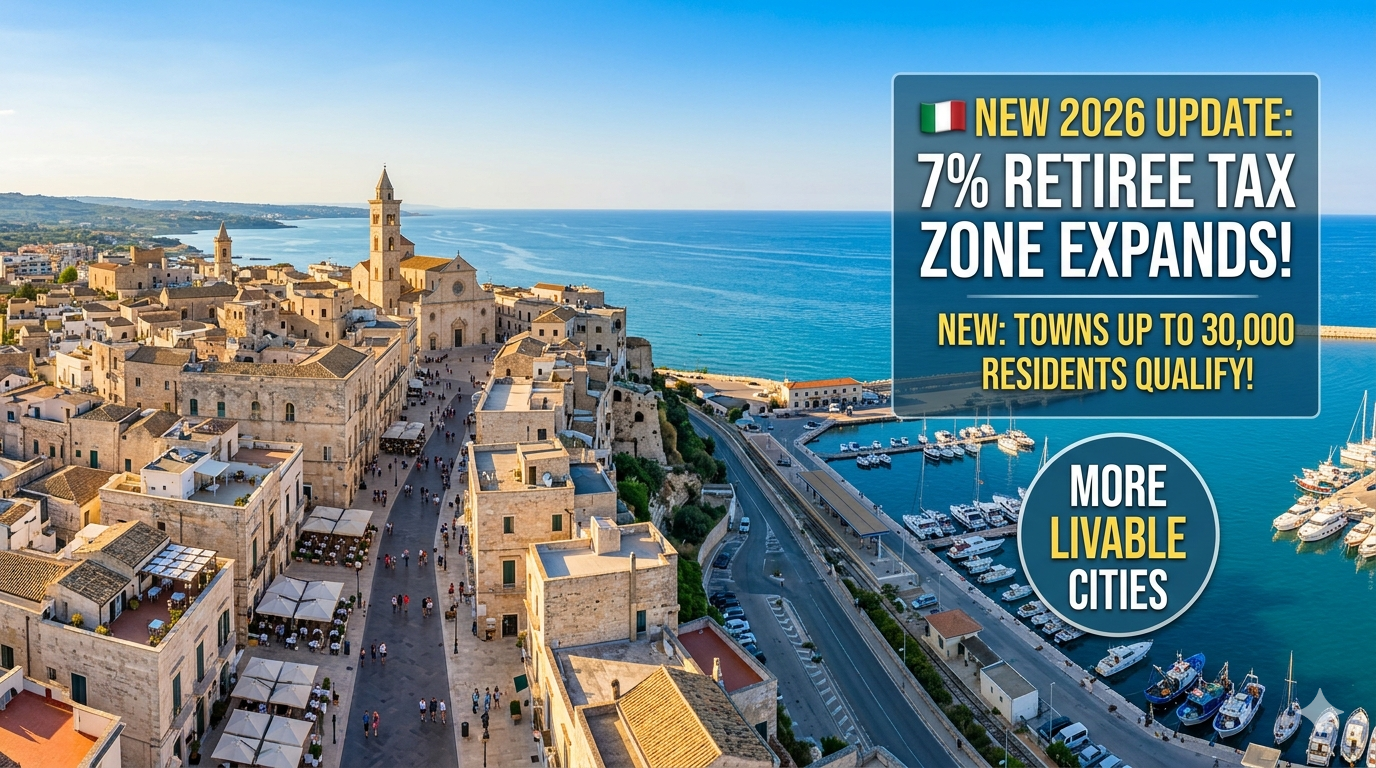
As of April 2026, qualifying foreign pensioners may benefit from the 7 percent substitute tax regime in eligible municipalities of Southern Italy and certain central areas, with the population threshold expanded to municipalities of up to 30000 inhabitants. The regime can apply for up to 10 years.
The high net worth alternative
For very wealthy applicants, Italy also offers the neo resident regime, which in 2026 applies a substitute tax of 300000 euro on foreign income, with an additional amount for qualifying family members who join the election.
Health insurance must be specific.
Basic travel insurance is often not enough. Many consulates want to see clear evidence of strong medical coverage, often including at least 30000 euro per person, hospitalization coverage, and repatriation or emergency evacuation language. After obtaining the Permesso di Soggiorno, some residents may also choose voluntary registration with the Italian National Health Service, depending on their situation.
After Arrival in Italy
Once you arrive, the next hurdle is the Permesso di Soggiorno. Many applicants submit the request through the Kit Giallo, the yellow application kit available at authorised Poste Italiane Sportello Amico counters. This step must generally be started within eight working days of arrival, and the competent office is tied to the area where you will reside.
Pro Tip for 2026
If you are applying as a couple, do not rely only on one shared account. Many applicants present a stronger file when each partner can show individual financial autonomy, such as separate pension statements, brokerage accounts, or other passive income streams. This can make the application easier to defend if the consulate asks follow up questions.
The Long Game
For many applicants, the Elective Residency Visa is the beginning of a longer immigration path. After 5 years of legal residence, you may become eligible for long term EU residency. After 10 years of legal residence, you may become eligible to apply for Italian citizenship through naturalization, subject to the legal requirements in force at that time.
If you’re considering a move to Italy, it’s important to seek legal advice to ensure a smooth transition. At Expat Living In Rome, we specialize in helping expats navigate the complexities of Italian law and bureaucracy. Our team of experienced lawyers can assist you with obtaining a residence permit, finding a job, and settling into your new life in Italy.
Italy’s coastline is a paradise for beach lovers, offering a variety of beautiful beaches accessible by train. For expats living in Italy, the convenience of train travel opens up a world of coastal adventures without the need for a car. Here’s a guide to some of the most spectacular Italian beaches you can easily reach by train.
Sestri Levante, Liguria
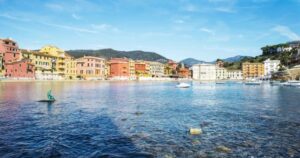
Whether you’re interested in history, outdoor adventures, or simply relaxing by the sea, Sestri Levante offers something for everyone. The town, also known as the City of Two Seas, features two picturesque bays: the Bay of Silence (Baia del Silenzio) and the Bay of Fables (Baia delle Favole), divided by an isthmus that connects the promontory, the oldest part of the village, to the mainland.
Local train Station: Sestri Levante.
Beaches in Sestri Levante
Bay of Silence (Baia del Silenzio)
The Bay of Silence is one of the most enchanting places on the Ligurian Riviera. It features crystal-clear water and fine sand, protected to the west by the massive Punta Manara promontory and surrounded by pastel-colored Ligurian houses and historic buildings. This delicate and precious ecosystem hosts vast meadows of posidonia and a wide variety of marine species, earning it the Blue Flag award for its environmental value. Access is regulated to preserve this unique environment, with visitor numbers limited during peak hours (8:00 AM to 5:00 PM).
Rules for Beach Access:
◦ Do not leave personal belongings unattended for more than 30 minutes.
◦ Do not litter.
◦ Do not use detergents.
◦ Do not remove sand, shells, or stones.
◦ Do not bring animals.
The Italian Naval League of Sestri Levante offers canoeing, rowing, and sailing courses for adults and children, focusing on educational activities in local schools.
The Bay Aquarium, located at Via Portobello 6, features four tanks showcasing common Mediterranean marine life. It is open daily from 8:00 AM to 8:00 PM. For more information, visit or email [email protected].
Bay of Fables (Baia delle Favole)
The larger bay, the Bay of Fables, was named by TV presenter Enzo Tortora in the late 1950s. This bay hosts the annual Hans Christian Andersen Bay of Fables Literary Prize, Italy’s most prestigious award for children’s literature, inspired by the Danish writer’s stay in Sestri Levante in 1833.
The bay is surrounded by historical and religious buildings, including the Church of San Nicolò dell’Isola, the Basilica of Santa Maria di Nazareth, the Church of the Immaculate Conception, and the Church of San Pietro in Vincoli. These structures reflect the village’s rich cultural heritage and offer a glimpse into its glorious past.
Sun Beach
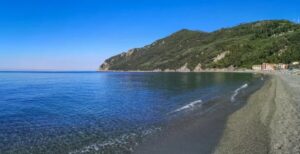
After hiking Punta Manara, take a refreshing dip in the sea at Sun Beach. The hike is of intermediate level and takes approximately 2.45 hours. Begin your journey from Sestri Levante’s city center on Via XXV Aprile, just a 5-minute walk from the railway station. Follow Vico del Bottone towards Punta Manara. Take Salita Mandrella on the left, passing through olive trees and vegetable gardens until you reach Casa Mandrella. From there, enjoy a panoramic stroll with magnificent views.
At Colla Mandrella (113 m), follow the right path through Mediterranean vegetation, including olives, oaks, strawberry trees, and maritime pines. Enjoy a break on a bench with a panoramic view or have a picnic. You can find a bivouac shelter at the “spianata del telegrafo,” where the ruins of an ancient watchtower offer a stunning coastal view.
Continuing on a steep brick stairway, you’ll see landscapes of Portofino and Riva Trigoso. On the return path, descend through Ginestra village and Le Rocche, ending on a recently renovated trail overlooking the beach, popular during the high season.
Taormina, Sicily
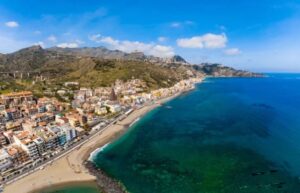
Located on the eastern coast of Sicily, Taormina offers mesmerizing views of the Ionian Sea and Mount Etna. The town is situated atop a hill about 250 meters (820 feet) above sea level, with a steep rock crowned by a Norman castle rising even higher, providing a striking and picturesque setting.
Getting to Taormina, Sicily by Train
Most journeys to Taormina involve taking a train that includes a ferry crossing across the Strait of Messina. Your train will arrive at Taormina-Giardini Naxos station, located below Taormina itself. From Taormina-Giardini Naxos station, you can reach Taormina town center (centro) by bus. If you purchase a ticket from Trenitalia to Taormina-centro station, the ticket will cover the entire journey.
Beaches in Taormina:
Giardini Naxos
Giardini Naxos is a coastal town known for being the first Greek colony in Sicily, founded around 734 BC. Today, it’s a modern beach resort town with a lively atmosphere, perfect for families and those seeking a mix of relaxation and exploration.
Legend has it that Naxos was founded by Naxos, a sailor from Chalcis in Greece, who landed here after being blown off course. The town quickly prospered due to its strategic location and fertile land. Over the centuries, Naxos was conquered by various civilizations, including the Romans and the Arabs. Today, it offers a glimpse into Sicily’s rich history alongside modern amenities.
Isola Bella:
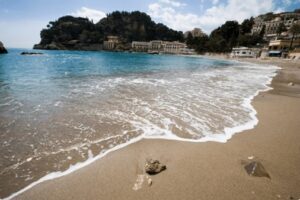
Isola Bella is a small island located just off the coast of Taormina. This fascinating little island is a nature reserve, boasting a lush botanical garden with exotic plants and flowers. The island also features the blue grotto and a small beach.
Isola Bella was once owned by a private family who transformed it into a botanical paradise. The island was acquired by the region in the 1990s and is now open to the public. Legend says that Odysseus, the hero of Homer’s Odyssey, encountered sirens near Isola Bella while sailing past Sicily.
How to Get to Isola Bella in Taormina
◦ Cable Car: The cable car station is located on Via Luigi Pirandello, near the Porta Messina gate (main entrance) of Taormina. The journey takes just a few minutes and offers breathtaking views of the coastline and Isola Bella itself. Tickets can be purchased at the station.
◦ Bus: Another good option is the local bus service. Bus line 25 runs from the center of Taormina to Isola Bella, with a travel time of approximately 15 minutes.
◦ Stroll: If you prefer walking, head through Via Pirandello to the viewing point “Belvedere terrace” and follow the path with steps that lead directly to the entrance of Isola Bella.
Mazzarò:
Mazzarò is a small resort area located north of Taormina. This charming spot offers a beautiful beach with crystal-clear waters and stunning views of the coastline. Mazzarò is known for its relaxed atmosphere and selection of upscale hotels and restaurants.
Mazzarò’s name likely comes from the Arabic word “manzil,” meaning “stopping place.” The area has been a popular destination for relaxation and enjoyment for centuries. In the 19th century, Mazzarò began to develop into a fashionable resort town, attracting wealthy travelers from all over Europe.
How to Get to Mazzarò in Taormina
◦ Cable Car: The cable car station is located on Via Luigi Pirandello, near the Porta Messina gate (main entrance) of Taormina. The journey takes just a few minutes and arrives directly at Mazzarò Beach.
◦ Bus: This is a more budget-friendly option, but it takes longer than the cable car. Take the Interbus toward Messina and get off at the “Mazzarò” stop. From there, it’s a short walk downhill to the beach.
◦ Stroll: To reach Mazzarò beach on foot, start from Piazza IX Aprile in Taormina’s historic center. Head south on the bustling Via Pirandello, lined with shops and cafes. After passing Porta Messina, the main gate, continue down the steeper Via Umberto I. Look for signs for the cable car station, but for a scenic and free alternative, take the stairway on your right that leads directly down to the coast.
Baia delle Sirene (Bay of Sirens):
Baia delle Sirene is a small cove located south of Taormina. This secluded beach is known for its calm waters and dramatic rock formations. The name “Bay of Sirens” comes from the Greek myth of the Sirens, enchanting creatures who lured sailors to their deaths with their beautiful songs.
Story: According to Homer’s Odyssey, Odysseus and his crew encountered Sirens while sailing past Sicily. Odysseus had his men plug their ears with beeswax and ordered himself to be tied to the mast to resist the Sirens’ seductive song.
How to Get to Baia delle Sirene in Taormina
◦ Bus: This is the most budget-friendly option. Take the Interbus toward Catania and get off at the “Baia delle Sirene” stop. From there, it’s a short walk to the beach (around 10 minutes).
◦ Stroll: Reaching Baia delle Sirene by foot is a challenging 3-kilometer trek with steep inclines, so it’s not for everyone. But if you’re feeling adventurous, follow the route suggested for Mazzarò beach: start at Piazza IX Aprile, head south on Via Pirandello and Via Umberto I, passing Porta Messina. After the cable car station area, continue down the main road instead of turning off. The incline gets steeper, but eventually you’ll arrive in Baia delle Sirene.
Alternative Activities in Taormina:
◦ Explore the Ancient Theatre: Visit the Taormina Greek Theater, an ancient amphitheater with stunning views.
◦ Mount Etna Volcano: Experience an off-road Jeep tour or hike around majestic Mount Etna.
◦ Alcantara Gorge: Hike, swim, or raft through this unique natural formation.
◦ Aeolian Islands: Hop around these beautiful islands from Taormina.
◦ Taormina Castle: Admire the ancient castle and its history.
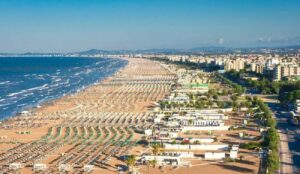
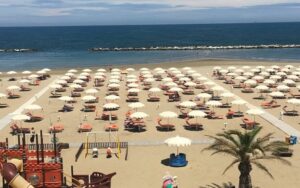
Rimini, Emilia-Romagna
Rimini, a vibrant city on the Adriatic Coast, is a popular summer destination for a reason. With its long stretches of sandy beaches, historical sites, and lively atmosphere, Rimini offers something for everyone.
Rimini boasts 15 kilometers of sandy beaches, perfect for soaking up the sun and enjoying the Adriatic Sea. Here are a few popular beaches you can explore:
Marina Centro
The main beach of Rimini, Marina Centro offers a lively atmosphere with numerous beach establishments (stabilimenti balneari) that rent sun loungers, umbrellas, and water sports equipment.
North of Marina Centro, Bellariva offers a more relaxed atmosphere with wide, sandy beaches. Here you’ll find families and couples seeking a quieter experience.
South of Marina Centro, Viserba is another popular beach area with a mix of free public beaches and private beach establishments. Viserba is also known for its nightlife options.
Alternative Activities in Rimini:
◦ Explore the historic center: Rimini has a rich history, evident in its Roman amphitheater, the majestic Tempio Malatestiano church, and the Tiberius Bridge, dating back to the 1st century AD.
◦ Immerse yourself in art and culture: Visit the Museo della Città (City Museum) to learn about Rimini’s history, or explore the beautiful Fellini Park dedicated to the famous Italian filmmaker Federico Fellini.
◦ Day trips to nearby towns: Take a day trip to charming towns like San Marino, a tiny independent republic nestled in the hills, or Ravenna, known for its Byzantine mosaics.
◦ Indulge in delicious food: Rimini offers a fantastic culinary scene. Savor fresh seafood dishes, savor the local Piadina flatbread, or enjoy a traditional pasta meal.
Viareggio, Tuscany
Viareggio, a coastal gem in Tuscany, beckons travelers with its sandy shores, charming atmosphere, and rich artistic heritage.
Local train Station: Viareggio.
Beaches in Viareggio
Viareggio boasts a long stretch of golden sand, perfect for sunbathing, swimming, and enjoying water sports. Here are some popular beaches to explore:
Marina di Viareggio:
The main beach of Viareggio, Marina di Viareggio offers a lively atmosphere with numerous stabilimenti balneari (beach establishments) renting sun loungers, umbrellas, and water sports equipment.
Spiaggia della Lecciona:
South of Viareggio, Spiaggia della Lecciona offers a more secluded and natural beach experience. This beach is known for its free public access and calmer waters.
Parco Naturale Migliarino San Rossore Massaciuccoli:
For nature lovers, explore the northern part of Viareggio’s coast. This protected area features a beautiful beach backed by pine forests, offering a unique blend of sun and nature.
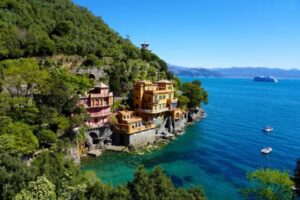
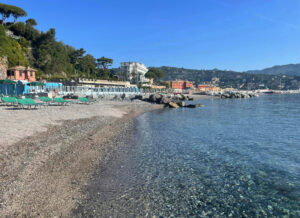
Santa Margherita Ligure, Liguria
Nestled on the Italian Riviera, Santa Margherita Ligure offers stunning coastal beauty, charming streets, and a relaxed atmosphere.
Local train Station: Santa Margherita Ligure-Portofino.
Beaches in Santa Margherita:
Baia di Paraggi:
Nestled just south of Portofino, Baia di Paraggi offers a captivating escape. This bay boasts crystal-clear waters ideal for swimming, a mix of public and private beaches for relaxation, and charming marinas. Explore the surrounding beauty on scenic walks, rent water equipment for an active adventure, or savor fresh seafood at waterfront restaurants.
To get to Paraggi Beach, start from the center of Santa Margherita Ligure and take the Provincial Road 227 towards Portofino. This is the only drivable link between the two towns. The road stretches for 4 km, carved into the Portofino promontory and hugging the coastline’s natural curves. For the best views, travel by bicycle, motorcycle, or walk along the pedestrian path. You’ll pass the distinctive Scoglio della Carega (or Sedia), enjoy the vistas of Punta Faro, and see the Castello di Paraggi before reaching the beaches of Paraggi or Niasca for a refreshing swim.
Spiaggia Minaglia:
This historic beach establishment in Santa Margherita Ligure is equipped with umbrellas and sunbeds, offering customers the rental of deck chairs, pedal boats, and canoes. The establishment also features a bar with light dining options. From the municipality of Santa Margherita Ligure, the beach can be easily reached on foot or by bicycle, as it is close to the port and the Santa Margherita Ligure monument.
Alternative Activities in Santa Margherita:
◦ Explore the charming town: Wander through the narrow streets lined with pastel-colored houses, discover local shops and cafes, and soak up the laid-back atmosphere.
◦ Hike the Portofino Peninsula: Lace up your hiking boots and explore the stunning trails of the Portofino Peninsula. Breathtaking views and hidden coves await.
◦ Day trip to Portofino: Take a boat tour or ferry to the exclusive village of Portofino, known for its colorful harbor, upscale boutiques, and luxurious atmosphere.
◦ Boat tour along the coast: Embark on a boat tour and admire the stunning coastline, with its hidden coves, charming villages, and dramatic cliffs.
Monterosso al Mare, Liguria
Monterosso al Mare, nestled within the Cinque Terre National Park, is a charming coastal village known for its stunning beauty, colorful houses, and relaxed atmosphere.
Local train Station: Monterosso al Mare.
Beaches in Monterosso al Mare:
Unlike the other Cinque Terre villages, Monterosso boasts a beautiful and spacious beach, perfect for sunbathing, swimming, and enjoying water sports.
Fegina Beach:
This long stretch of golden sand is the main beach of Monterosso. It offers both free public areas and private stabilimenti balneari (beach establishments) renting sun loungers and umbrellas. The beach also features a charming seaside promenade lined with shops and restaurants.
Alternative Activities in Monterosso al Mare:
◦ Explore the historic center: Wander through the narrow streets lined with colorful houses, discover local shops and cafes, and soak up the village’s charming atmosphere.
◦ Hike the Cinque Terre trails: Lace up your hiking boots and explore the stunning trails that connect Monterosso to the other villages of Cinque Terre. These cliffside paths offer breathtaking views of the coastline.
◦ Boat tour: Embark on a boat tour and admire the Cinque Terre villages from a different perspective. You can also access hidden coves and secluded beaches only reachable by water.
◦ Visit the Church of San Francesco: This 17th-century church houses a beautiful crucifix by the renowned Flemish painter Van Dyck.
Cefalù, Sicily
Cefalù, nestled on the northern coast of Sicily, captivates visitors with its medieval charm, golden beaches, and stunning views of the Tyrrhenian Sea. The iconic Norman Cathedral, perched atop a rocky promontory, adds to the town’s allure.
Local train Station: Cefalù.
Beaches in Cefalù
Spiaggia di Settefrati, also known as Baia dei sette emiri:
A picturesque beach renowned for its breathtaking panoramic beauty. The bay is encircled by lush greenery and dotted with small, rugged coves. Numerous rocky formations emerge from the sea, including both low, walkable rocks and impressive faraglioni (sea stacks). The crystal-clear, transparent waters teem with a rich variety of fish, making it an ideal spot for snorkeling and enjoying the serene natural environment. This idyllic setting offers a perfect escape for nature lovers and beachgoers alike.
Spiaggia di Cefalù:
This is the main beach in Cefalù, located right in front of the town’s historic center. It’s known for its golden sand, clear blue waters, and convenient amenities such as beach clubs, restaurants, and bars. The backdrop of the town’s medieval architecture and the towering La Rocca add to its charm, making it a perfect spot for both relaxation and sightseeing.
Caldura Beach:
Located a short distance from the center of Cefalù, Caldura Beach is a bit more secluded and tranquil. This pebbly beach is surrounded by rocky cliffs and lush vegetation, offering stunning views and a more intimate atmosphere. It’s ideal for those looking to escape the crowds and enjoy some peaceful sunbathing or snorkeling.
Alternative Activities in Cefalù
◦ Hike to La Rocca: Head up to La Rocca for stunning views over the sea. The hike is rewarding, and the panoramic vistas are worth the effort.
◦ Wine Tasting in Madonie Mountains: Join a wine tasting tour in the Madonie Mountains. Sicily is known for its excellent wines, and this experience allows you to savor local flavors.
◦ Sail the Seas: Consider a four-hour sailing tour to explore the coastline from a different perspective.
◦ Hike Etna: For adventure seekers, hiking up the active volcano Mount Etna is an unforgettable experience.
Camogli, Liguria
Located on the western side of the Portofino peninsula in Liguria, Camogli charms visitors with its vivid, multicolored houses. The picturesque landscape is further enhanced by the remnants of a medieval castle. The 12th-century Basilica of Santa Maria Assunta, situated on an ancient rock-island, once stood at the core of the village’s political and religious life. The combination of the sea, beach, and colorful buildings makes Camogli a captivating coastal destination.
Local train Station: Camogli-S. Fruttuoso.
Beaches in Camogli
Camogli Beach:
Camogli Beach is an ideal spot for leisurely sunbathing and unwinding. Visitors can relax on the golden sands and take a dip in the clear waters, which are perfect for swimming and snorkeling. Along the beach, a charming promenade is lined with inviting cafes, gelato shops, and seafood restaurants, offering plenty of options for refreshments and meals. The beach is beautifully framed by the iconic pastel-colored houses that overlook the shoreline, adding to the picturesque and relaxing atmosphere of this coastal gem.
San Fruttuoso:
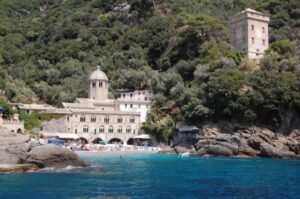
San Fruttuoso is a picturesque beach located in the charming fishing village of San Fruttuoso, nestled between Camogli and Portofino. Accessible only by foot or sea, its lush greenery, crystal-clear waters, and the medieval San Fruttuoso Abbey create a magical atmosphere. Divers are drawn to this spot for the “Christ of the Abyss” statue, which has been submerged since 1954 to honor scuba pioneer Dario Gonzatti. This underwater sculpture adds to the beach’s allure. The white sand beach, framed by steep cliffs, provides shelter from strong winds, making it an ideal spot for sunbathing, swimming, and snorkeling.
Punta Chiappa Beach:
Located within the Portofino Regional Natural Park and the municipality of Camogli, offers a serene and relaxing escape in a pristine coastal area. You can reach Punta Chiappa on foot along a trail in the Portofino Natural Park or by sea. The path begins at a small dead-end road off Viale Cuneo, directly opposite the Carabinieri barracks. This is Via San Bartolomeo, a mule track that ascends into the interior, initially following the course of the Gentile stream. The walking time is approximately 30 to 60 minutes at a regular pace.
Alternative Activities in Camogli
◦ Explore the Medieval Past: Discover the remnants of the once-powerful medieval castle that stood guard over the village. Unveil the history of the 12th-century Basilica of Santa Maria Assunta, a former heart of the town’s religious and political life.
◦ Boat Tours and Kayaking: Take in the stunning coastline from a different perspective. Embark on a boat tour or rent a kayak to explore hidden coves, secluded beaches, and the dramatic rock formations along the shore.
◦ Festivals and Events: Time your visit to coincide with a local festival. The “Sagra del Pesce” (Fish Festival) held on the second Sunday of May is a must for seafood lovers, offering a chance to experience the town’s vibrant traditions and culinary heritage.
Whether you’re an expat or a traveler, these destinations provide a perfect blend of relaxation, culture, and natural beauty, all accessible without the need for a car. What other beaches would you add to this list? Share your favorite coastal spots and let us know why they deserve a visit!
Subscribe to our newsletterto access content and updates to help navigate life as an expat in Italy. If you need help with your citizenship process, language courses, or general expat life in Italy, email us at [email protected].
Big news for Italian retirement: You no longer have to live in a tiny village to save 93% on taxes.
As of April 7, 2026, the Italian government officially raised the population threshold for the famous 7% tax regime. Previously limited to villages under 20,000 people, the limit has jumped to 30,000 residents.
🏥 Better Infrastructure
Access to larger regional hospitals and specialized medical care that smaller villages lack.
🎭 Lively Culture
UNESCO sites like Noto and Alberobello are now fully eligible for the tax break.
✈️ Global Connectivity
Coastal hubs with easier access to international airports and high-speed rail.
Financial Impact: Standard vs. 7% Regime
Income Source
Standard Italian Tax
7% Special Rate
Foreign Pension
23% to 43%
7% Fixed
Investment Dividends
26%
7% Fixed
Rental Income (Abroad)
Progressive Rate
7% Fixed
Newly Eligible Towns: 2026 Highlights
Below are the most popular additions to the list, grouped by region. These towns were previously “too big” but now fall under the 30,000 resident cap.
SICILY
• Noto
• Taormina
• Castelvetrano
• Termini Imerese
• Misilmeri
• Belpasso
PUGLIA
• Alberobello
• Manduria
• Canosa di Puglia
• Gioia del Colle
• San Giovanni Rotondo
CAMPANIA
• Pompei
• Paestum
• Poggiomarino
• San Nicola la Strada
Just because a town has 25,000 people doesn’t mean it automatically qualifies. It must be located in the regions of Sicily, Sardinia, Calabria, Campania, Puglia, Basilicata, Abruzzo, or Molise. Towns in Northern or Central Italy (like Tuscany or Lombardy) do not qualify for the 7% rate, regardless of their size.
How to use our “Town Finder” Strategy
Before you buy property, you must verify the official resident count. Here is how to do it accurately:
Step 1: The ISTAT Verification
Visit the ISTAT (Italian National Institute of Statistics) website. Look for the “Resident Population” data as of January 1st of the current year. The town must be under 30,000.
Step 2: Regional Eligibility
Ensure the town is in Sicily, Calabria, Sardinia, Campania, Basilicata, Abruzzo, Molise, or Puglia (or specific earthquake zones in Central Italy).
Step 3: Professional Audit
Because population counts change, we recommend a pre-purchase audit. We verify the specific municipality’s status with the Revenue Agency (Agenzia delle Entrate) to ensure your 7% status is 100% secure.
Beware of “Frazioni”: Sometimes a small village is actually part of a larger city (like Rome or Naples). If the main municipality is over 30k, the village usually won’t qualify.
Pro Tip: Population counts change every year. We offer a “Safe-Move Audit” where we get a written confirmation of the town’s status before you sign a lease.
Don’t Guess Your Tax Status
The 7% regime lasts for 10 years—making a mistake on the town choice can cost you thousands. Let our experts verify your eligibility today. CONSULT WITH A TAX SPECIALIST
After years of anticipation, Italy’s Digital Nomad Visa is officially in full swing.
This visa is a game-changer for non-EU citizens who want to trade their home office for a sun-drenched balcony in Rome or a villa in Tuscany. However, because it is a relatively new category, there is still a lot of confusion regarding who actually qualifies and what the Italian authorities are looking for in an application.
The most important thing to understand is that this visa is reserved for “highly skilled” workers. This means you aren’t just working remotely; you must be able to prove your professional expertise through education or significant work experience. Below, we’ve broken down the current 2026 requirements to help you decide if this is the right path for your move to Italy.
The Financial Requirements
To maintain its healthcare and social systems, Italy requires digital nomads to show a stable and significant income. For 2026, the minimum annual income requirement is approximately €28,000. This must come from remote work for companies or clients located outside of Italy.
When applying, you will need to provide at least six months of bank statements to show that this income is consistent. Consulates are looking for stability—they want to see that you won’t be a financial burden on the state and that your remote career is established enough to support you long-term.
Professional Qualifications & Experience
Italy defines “highly skilled” in a very specific way. To qualify, you generally need to meet one of the following criteria:
— A university degree (typically a Bachelor’s or higher) in your field of work.
— At least three to five years of documented professional experience if you do not have a degree.
— Proof that you have been working in your current remote role for at least six months prior to applying.
The Logistics: Insurance and Housing
You cannot apply for the Digital Nomad Visa with just a “plan”—you must show proof of a place to live. This means having a registered lease agreement or property deed in Italy ready for your application. Short-term Airbnb bookings are generally not accepted for the long-stay D-Visa.
Additionally, you must have comprehensive health insurance that covers you for at least €30,000 per year in Italy. This policy must cover hospitalization and repatriation. Once you arrive in Italy and receive your residency permit (*Permesso di Soggiorno*), you may also have the option to pay into the Italian National Health Service (SSN).
Tax Realities: The “Impatriate” Benefit
One of the biggest “realities” of moving to Italy is the tax regime. The good news for 2026 is that many digital nomads can take advantage of the Impatriate Regime. This allows remote workers who move their tax residence to Italy to receive a 50% tax exemption on their income for up to five years. This can make the cost of living in Italy significantly more affordable, but it requires careful planning with a tax professional to ensure you meet all the residency requirements.
Ready to Make the Move?
Navigating the Digital Nomad Visa alone can lead to months of delays and potential rejections. Our expert relocation team specializes in helping expats bridge the gap between “dreaming” and “driving” in Italy.
Buying Property in Italy: 4-Phase Strategic Purchase Plan
A comprehensive framework for expats and investors to navigate the Italian real estate market with professional precision.
Do you dream of a farmhouse in Tuscany, a luxury villa on Lake Como, or a seaside home in Puglia? Whether you are looking for an investment apartment in Rome or a historic property in Florence, buying a home in Italy as a foreigner is a significant milestone.
We operate exclusively in your interest as Property Finders—your personal strategic consultants. We are not a real estate agency; we provide conflict-free advice focused solely on identifying the best deals and ensuring a 100% secure purchase process from start to finish.
💡 Insider Tip #1: The Power of the “Written” Offer
In Italy, verbal agreements carry no legal weight. To secure a property, you must submit a formal Proposta d’Acquisto accompanied by a small deposit. This “locks” the seller into exclusivity while your lawyers conduct their final checks.
💡 Insider Tip #2: Beware of “Abusi Edilizi”
Many historic Italian homes have internal modifications that were never officially filed with the municipality (Comune). We ensure a Geometra verifies the floor plans before you sign, preventing you from inheriting costly legal fines.
The 4-Phase Strategic Purchase Plan
Phase 1: FREE Discovery CALL
A 30-minute call to discuss your vision and uncover high-potential properties.
Phase 2: Roadmap
A 60-minute deep dive to refine your target area, budget, and legal requirements.
Phase 3: Scouting
Filtering the market, providing virtual tours, and accessing off-market deals.
Phase 4: Closing
Negotiation, technical due diligence, and full notary coordination.
Our Proven Expertise Across Italy
🏛️
Urban Investments
Rome, Florence & Venice
High-yield apartments and historic residences in Italy’s most iconic art cities.
🍷
Exclusive Retreats
Tuscany & Umbria
Luxury farmhouses, vineyards, and sprawling estates in the heart of the countryside.
🌊
Coastal Luxury
Sardinia & Sicily
Premier villas and waterfront properties along the Mediterranean’s finest coastlines.
🏺
Southern Heritage
Puglia & Naples
From the unique Trulli of Valle d’Itria to the vibrant, historic palazzos of Naples.
🏔️
Hidden Gems
Abruzzo & The North
Authentic mountain retreats and lakeside living for those seeking off-market value.
🏨
Commercial Estates
Nationwide
Boutique hotels, B&Bs, and hospitality ventures for international investors.
The 10-Point Secure Purchase Checklist
Essential steps for every foreign buyer.
✅ Obtain Codice Fiscale
✅ Verify Land Registry
✅ Check Energy Cert (APE)
✅ Verify Building Permits
✅ Open Italian Bank Account
✅ Hire Independent Surveyor
✅ Review Condo Debts
✅ Confirm Mortgage Terms
✅ Draft Written Proposta
✅ Appoint Interpreter
Don’t leave your Italian investment to chance—download the essential checklist to ensure your purchase is 100% legally secure.
Confusion with Italian Bureaucracy: How Things Will Not Change… But You Will!
If you’ve ever tried to navigate Italian bureaucracy as an expat, you probably know the feeling: confusion, frustration, and the sense that everything moves in circles. Forms lead to other forms. Offices send you to other offices. And sometimes the information you’re given depends entirely on who you ask that day.
But here’s the truth many of us learn after living here for a while: Italian bureaucracy probably isn’t going to change. But you will. And that’s actually the key to surviving — and eventually mastering — life in Italy as an expat.
Recently, I was speaking with Alice, an American who has been navigating the system here in Rome. Our conversation reminded me how common these experiences are for foreigners trying to figure out residency, healthcare, and paperwork in Italy.
The Paperwork Circle
Alice described the experience in a way that many expats immediately recognize. “It’s all a circle,” she said. “You need one document to get another document, but then the second document requires the first one.” If you’ve gone through residency registration or immigration procedures in Italy, you’ve probably experienced this loop.
For example, in order to register with your comune (local municipality), you may need documentation connected to immigration status. But sometimes immigration offices require proof of local registration or address before they can finalize certain steps. That’s when the frustration begins.
Alice and her family had filed paperwork and waited months, assuming the process was moving forward. Then when they finally went to immigration, the officer pulled out their file and asked a question that stopped them cold: “Who told you to do this procedure?” And that’s when they realized the information they had been given earlier might not have been the correct path.
One thing that does not change in Italy is the importance of the codice fiscale. If you are new to Italy, think of it as your universal identification number. You need it for almost everything: renting an apartment, opening a bank account, getting utilities, accessing healthcare, registering for residency, and signing contracts.
But what many expats don’t realize is that so much information gets tied to that number. “We didn’t even know,” she said. “The phone number was printed on the card the whole time.” Sometimes the information exists, but no one has explained how it connects to the rest of the process. That’s where many expats get stuck.
Immigration vs. Consulates: A Common Misunderstanding
Another thing that confuses many expats is where immigration procedures actually happen. A lot of people believe they must go through their home country’s consulate for certain steps. But once you’re living in Italy, most immigration procedures happen through the Questura, the local immigration police office.
Alice explained how people often give advice online that may not apply to Rome or to Italy’s system in general. “I tell people all the time,” she said, “you don’t go through your consulate. You go through immigration. You go to your local immigration office.” Every city can operate slightly differently, which is why information from other expats doesn’t always translate perfectly.
Healthcareis another area where expats quickly realize that the system is different from what they’re used to. Italy has an excellent public healthcare system called the Servizio Sanitario Nazionale (SSN). Once you are properly registered, you can access public doctors, prescriptions, and medical services.
But getting into the system requires a few steps: registering residency, enrolling in the health service, and choosing a local doctor (medico di base). And here’s another surprise for many expats: you cannot just choose any doctor someone recommends. “You have to pick one in your district,” Alice explained. “Anyone can give you their doctor’s name, but you still have to go to the one in your area.” That can be another obstacle, especially if you’re trying to find an English-speaking doctor.
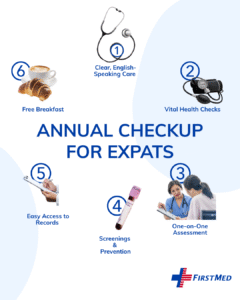
Because of language barriers and bureaucracy, many expats rely on private clinics while they are figuring out the system. One example is FirstMed, which has become a popular option for international residents in Rome and Milan. Clinics like FirstMed focus on serving expats and travelers, offering English-speaking doctors and staff who understand the challenges foreigners face when navigating healthcare in Italy.
“They must be doing something right,” Alice said. “They opened just this year a clinic in Milan and they even have one in Budapest.” That kind of expansion shows how much demand there is for healthcare providers that specialize in helping international patients. Private clinics can also help bridge the gap while you are waiting to complete the paperwork required for the public healthcare system.
Things May Not Change… But You Will
Italy is famous for many things — art, food, culture, history. But bureaucracy is part of the landscape too. The key to surviving it is patience, curiosity, and a sense of humor. Because the reality is this: Italian bureaucracy probably won’t change. But as an expat living here, you will.
You’ll learn how the system works. You’ll build relationships with local offices. You’ll discover resources like clinics such as FirstMed that understand the expat experience. And eventually, what once felt impossible will become just another part of life in Italy. And that’s when you know you’ve truly adapted.
A unique initiative comes from Celleno, Italy (province of Viterbo), a small village about 90 minutes from Rome: the “Ghost Egg Hunt”, which will take place on Easter Monday (April 6, 2026) in the area’s well-known “ghost town” in the Tuscia region of central Italy.
Between 200 and 400 visitors are expected in Celleno, Italy, taking part in the search for one or more “ghost eggs” hidden throughout the historic center and around the Orsini Castle. The activity will take place from the morning throughout the entire day, around the ghost village and in the surroundings of the castle.
The initiative has been officially announced by the Mayor of Celleno, Italy, Luca Beraldo, marking the first edition of the event.
The activity is designed as a playful and exploratory experience for children, families, and visitors, who will be invited to find symbolic “ghost eggs” hidden across the ancient village. Participation is free and part of the Easter holiday celebrations in Italy.
“We invite everyone, both young and old, to take part in this day,” said Mayor Luca Beraldo. “It will be an opportunity to experience the village in a different way, driven by curiosity and discovery. A moment of community, fun, slow tourism, and religious celebration, where families and visitors can share a special day together.”
The ancient village of Celleno, Italy, gradually abandoned after World War II due to earthquakes and geological instability, is now partially open to visitors and has become one of the most visited destinations in the Tuscia area during holidays and weekends in Italy.
FOR JOURNALISTS – BACKGROUND ON PARANORMAL REPORTS AND HISTORICAL CONTEXT
Located in the province of Viterbo, about one hour from Rome in central Italy, the village of Celleno – now also known as the “Ghost Village” – was gradually abandoned after World War II due to earthquakes and geological instability.
Over time, restoration efforts have made part of the site accessible to visitors. Today, it can be explored as an open-air historical site, featuring a “scattered museum” with traces and remains from Etruscan and medieval periods.
The village was also highlighted by The Telegraph as one of Italy’s “most beautiful places lost in time.”
Over the years, Celleno has also become associated with stories about the so-called “ghost of the village,” often linked to historical events involving the powerful Gatti Family. Giovanni Gatti, the last prominent member of this noble family, was killed in Celleno on May 27, 1496, in the main square near the castle—an episode that has contributed over time to the legends and mysterious narratives surrounding the village.
Alongside these stories, investigations conducted by the Centro Italiano Studi Paranormali (Italian Center for Paranormal Studies) have documented unusual phenomena detected through technical instruments, although no definitive conclusions have been reached.
For approximately forty years, the Orsini Castle was inhabited exclusively by the internationally renowned artist Enrico Castellani, who lived and worked there until his death. Here he created many of his works, now exhibited in major museums worldwide, with some reaching values of several million euros.
Big news for Italian retirement: You no longer have to live in a tiny village to save 93% on taxes. As of April 7, 2026, the Italian government officially raised the population threshold for the famous 7% tax regime. Previously limited to villages under 20,000 people, the limit has jumped to 30,000 residents. 🏥 Better […]
Buying Property in Italy: 4-Phase Strategic Purchase Plan A comprehensive framework for expats and investors to navigate the Italian real estate market with professional precision. Do you dream of a farmhouse in Tuscany, a luxury villa on Lake Como, or a seaside home in Puglia? Whether you are looking for an investment apartment in Rome […]
Italy offers several tax incentives designed to attract retirees, entrepreneurs, high-net-worth individuals and remote workers. These regimes can be extremely generous — but they are complex and often conditional. This guide explains the main options in 2026, who qualifies, and how we can help you plan a compliant move. Why Italy Offers Tax Incentives Italy […]
Looking to buy property in Italy? We are here to help you step by step! Have you always dreamed of owning a home in Italy—whether it’s a charming countryside farmhouse, a coastal villa, or a cozy apartment in a historic town? We’re here to help turn that dream into reality. Buying real estate in […]
April in Italy is the “sweet spot”—the wisteria is blooming, the crowds haven’t fully peaked, and the calendar is packed. Here are the must-know events for your community.
1. Pasqua & Pasquetta (Easter Weekend)
Dates: April 5 (Easter Sunday) & April 6 (Easter Monday)
The Vibe: Pure tradition. Rome will be very busy with the Pope’s Urbi et Orbi blessing.
Expat Tip: Remind your followers that Pasquetta is the day for “scampagnata” (a rural picnic). If they haven’t booked a countryside restaurant or grabbed picnic supplies by Saturday, they’ll be hungry on Monday!
2. Vinitaly (Verona)
Dates: April 12 – 15, 2026
The Vibe: The world’s largest wine exhibition.
Expat Tip: This is a professional fair, but the “Vinitaly and the City” events in the center of Verona are perfect for your casual wine lovers. It’s a great “Meetup” opportunity if any of your 34k members are in the North.
3. Salone del Mobile & Fuorisalone (Milan Design Week)
Dates: April 14 – 19, 2026
The Vibe: Milan becomes the coolest city on earth.
Expat Tip: Tell your followers to focus on the Fuorisalone (the events in the Brera and Tortona districts). Most are free, involve great cocktails, and offer incredible “people watching.”
4. Natale di Roma (Rome’s 2,779th Birthday!)
Date: April 21
The Vibe: Since you have 48k members in Rome, this is a big one. Expect historical reenactments, gladiators in the Circus Maximus, and parades.
Expat Tip: It’s a fantastic day for photos. Tell them to head to the Aventine Hill for the best views of the celebrations.
5. Liberation Day (Festa della Liberazione)
Date: April 25
The Vibe: A national holiday marking the end of WWII in Italy.
Expat Tip: This falls on a Saturday in 2026. This means a “Ponte” (long weekend) isn’t really happening, but many locals will still head to the coast or the lakes. Expect heavy traffic!
6. Venice: Feast of St. Mark
Date: April 25
The Vibe: While the rest of Italy celebrates Liberation, Venice also celebrates its patron saint.
The Tradition: Men give a single red rosebud (bocolo) to the women they love. A great “fun fact” to share in your groups!
Planning Your April in Italy? 🌷
April is a season of transition here—the weather can be “ballerino” (dancing between sun and rain!), but the energy is unmatched. Whether you are heading to Milan for Design Week or enjoying a quiet picnic in the Tuscan hills for Pasquetta, we hope you find that perfect “Dolce Vita” moment.
A quick tip from our team: April 25th (Liberation Day) falls on a Saturday this year, so expect cities to be bustling and restaurants to fill up fast. If you haven’t made your lunch reservations yet—do it today!
Italy offers several tax incentives designed to attract retirees, entrepreneurs, high-net-worth individuals and remote workers. These regimes can be extremely generous — but they are complex and often conditional. This guide explains the main options in 2026, who qualifies, and how we can help you plan a compliant move.
Why Italy Offers Tax Incentives
Italy wants to attract investment, fresh talent and long-term residents to boost local economies — especially outside major cities. Tax incentives are tools to encourage relocation, entrepreneurship and pensioner migration to Italy’s regions.
Quick takeaway: These programs can cut your tax bill significantly — but they require careful documentation, residency compliance and ongoing reporting.
Major Incentive Programmes (Overview)
1. Flat-Tax for New Residents (Art. 24-bis)
What it is: a substitute flat tax on foreign-source income. As of 2026, a common benchmark is €200,000/year for the principal applicant (with additional rules for family members).
•Who it’s for: high-net-worth individuals moving their tax residence to Italy. •Duration: typically up to 15 years (elective regime; check local rules). •Note: the rate and requirements have changed in recent years and further increases have been proposed for future applicants — plan accordingly.
2. Impatriate / Rientro dei Cervelli Regime
What it is: a favourable tax regime for skilled workers, executives and freelancers who relocate to Italy for work. In many cases a portion (e.g., 50%) of employment or self-employment income is exempt from Italian tax for a limited period.
•Who it’s for: qualifying employees or self-employed professionals who weren’t tax residents recently in Italy. •Typical benefit: partial exemption on income (often 50%, rising in specific family/region cases). • Term: often 5 years with possible extensions under certain conditions.
3. 7% Flat Tax for Foreign Pensioners in Small Southern Towns
What it is: a highly attractive 7% tax on foreign-source pension income for up to 10 years if you move to qualifying municipalities (usually under 20,000 residents) in specified southern regions.
• Who it’s for: foreign pensioners who commit to living in qualifying small towns. • Why it matters: extremely low tax rate compared with many countries.
Key Requirements & How to Qualify
Although each scheme has its own rules, there are common requirements you must meet:
• Tax residence in Italy: typically >183 days in Italy per year, or registration with the anagrafe (resident registry) and proof the centre of your life is in Italy.
• Non-residence condition: many regimes require you were not tax resident in Italy for a certain number of previous years.
• Stable income: documented passive income or eligible employment income, depending on the regime.
• Accommodation: proof of housing in Italy (rental contract or deed) and genuine intention to reside.
• Insurance & compliance: private health insurance where required; timely tax filings and residency maintenance.
• Heads up: Consulates and local tax offices (agenzia delle entrate) sometimes apply discretion and local interpretation. That’s why preparing strong documentation matters.
What’s Changing — Policy Watch (2026)
Italian tax incentives have evolved quickly. Recent developments to watch:
• The flat-tax for new residents has been raised in recent years (previously €100k → €200k), and proposals to raise it further have been discussed in draft budgets. Changes may affect future applicants. • Regional add-ons and special municipal incentives (to attract residents to small towns) can appear and disappear — timing is important. • Law and regulations are updated frequently; always verify rules for the year you plan to move.
How We Help — Our Services
At Expats in Italy / Expats Living in Rome we support clients through the full planning and relocation process:
• Consultation to review your profile, income sources and relocation goals. • Strategy call (30–60 mins) to design the timeline, choose the right regime and list documents required. • Document collection & review: we help you gather proof of non-residence, income, accommodation and identify gaps. • Introductions to trusted commercialisti & notaries: implementation partners who handle tax filings, elections and notarial needs. • On-the-ground support: assistance with anagrafe registration, health insurance options, opening an Italian bank account and residency procedures.
Is a Tax Incentive Right for You?
Ask yourself:
• Is most of my income foreign-sourced (pension, rents, dividends, investments)? • Can I realistically spend most of the year in Italy and establish residency? • Have I been non-resident in Italy for the required look-back period? • Am I prepared to engage with Italian tax and legal advisors for compliance? • If you answered yes to several of the above, it’s worth exploring — but planning is essential.
Disclaimer: This post provides general information and is not legal or tax advice. Rules change frequently. Consult a qualified tax advisor or lawyer before making decisions. Contact us and speak to an expert in relocation today!
Big news for Italian retirement: You no longer have to live in a tiny village to save 93% on taxes. As of April 7, 2026, the Italian government officially raised the population threshold for the famous 7% tax regime. Previously limited to villages under 20,000 people, the limit has jumped to 30,000 residents. 🏥 Better […]
Buying Property in Italy: 4-Phase Strategic Purchase Plan A comprehensive framework for expats and investors to navigate the Italian real estate market with professional precision. Do you dream of a farmhouse in Tuscany, a luxury villa on Lake Como, or a seaside home in Puglia? Whether you are looking for an investment apartment in Rome […]
Italy offers several tax incentives designed to attract retirees, entrepreneurs, high-net-worth individuals and remote workers. These regimes can be extremely generous — but they are complex and often conditional. This guide explains the main options in 2026, who qualifies, and how we can help you plan a compliant move. Why Italy Offers Tax Incentives Italy […]
Looking to buy property in Italy? We are here to help you step by step! Have you always dreamed of owning a home in Italy—whether it’s a charming countryside farmhouse, a coastal villa, or a cozy apartment in a historic town? We’re here to help turn that dream into reality. Buying real estate in […]
Easter, or “Pasqua,” is one of the most significant and beautiful times to be in Italy.
In 2026, Easter Sunday falls on April 5th, bringing with it a week of profound religious traditions, vibrant spring festivals, and, of course, incredible seasonal food. Whether you are a religious pilgrim, a history enthusiast, or an expat looking to experience local life, here is your guide to celebrating Easter across the Italian peninsula in 2026.
Join us for an Easter Sunday Social Dinner with fellow expats at Alle Fratte!
This event is designed to make new friends among fellow expats and visitors to Rome in a warm and welcoming atmosphere. Please note that only 20 tickets are available, and they tend to sell out quickly. Reserve now!
The Holy Week Schedule for 2026
The celebrations begin with Palm Sunday on March 29th, marking the start of “Settimana Santa” (Holy Week). Throughout this week, you will see solemn processions in cities and small villages alike.
On Maundy Thursday, April 2nd, many churches hold the ritual of the Washing of the Feet. Good Friday, April 3rd, is a day of deep reflection. While it is not a national public holiday in Italy (offices and shops remain open), the evening is marked by the moving “Via Crucis” (Way of the Cross) led by the Pope at the Colosseum in Rome, starting at 9:15 PM.
Holy Saturday, April 4th, is a day of quiet anticipation leading up to the Easter Vigil mass in the evening. Easter Sunday, April 5th, is the grand celebration of the Resurrection. In Rome, thousands gather in St. Peter’s Square for the Pope’s “Urbi et Orbi” blessing at noon.
Unique Traditions Across Italy
Florence hosts one of the most spectacular events on Easter Sunday morning: the “Scoppio del Carro” (Explosion of the Cart). A 500-year-old ornate wagon is pulled through the streets by white oxen to the Duomo. During the mass, a mechanical dove-shaped rocket slides down a wire to ignite the cart, which is filled with fireworks. A successful explosion is traditionally said to guarantee a good harvest for the year.
In Sicily, particularly in towns like Enna and Trapani, Holy Week is marked by ancient and dramatic processions where hooded figures carry heavy, ornate statues through the streets. These events are deeply emotional and have remained largely unchanged for centuries.
Pasquetta: Easter Monday
Easter Monday, or April 6th, 2026, is known as “Pasquetta” (Little Easter). This is a national holiday in Italy and is traditionally a day for “una gita fuori porta” (a trip outside the city gates). Italians head to the countryside, the beach, or the mountains for a massive picnic with friends and family. It is a relaxed, social day that marks the unofficial start of the spring excursion season.
What to Eat: Traditional Easter Flavors
Food is at the heart of the Italian Easter experience. You will find “Colomba di Pasqua” in every bakery—a dove-shaped sweet bread similar to Panettone but topped with pearl sugar and almonds. Savory breads are also popular, such as “Casatiello” from Naples, which is stuffed with cheese, salami, and whole eggs.
Lamb is the traditional main course for the Easter Sunday feast, often roasted with rosemary and potatoes. For dessert, in addition to the Colomba, chocolate eggs are a massive tradition. These aren’t small treats; Italian Easter eggs are often giant, beautifully wrapped, and contain a “sorpresa” (surprise) inside.
Travel Tips for Expats in 2026
Since Easter Sunday and Monday (April 5-6) are national holidays, expect many shops and local businesses to be closed. Public transport will run on a “festivo” (holiday) schedule, which usually means fewer runs. If you plan to visit major museums or the Vatican, book your tickets weeks in advance, as this is one of the busiest travel weeks of the year.
Easter in Italy is a time of renewal and community. Whether you are sharing a slice of Colomba with neighbors or watching a centuries-old procession, the atmosphere is unlike any other time of year.
Need Help with Your Life in Italy?
If you are navigating the complexities of residency, need document retrieval for your citizenship application, or require certified translations, our team is here to support the expat community. Let us handle the bureaucracy so you can focus on enjoying the beauty of the Italian spring.
Contact us at [email protected] to schedule a consultation or to learn more about our relocation services.
Spring in Italy is a magical time. The weather is warm but not too hot, the flowers are in full bloom, and the cities come alive with festivals, outdoor activities, and cultural events. For expats living in Italy, it’s the perfect time to explore the country’s diverse landscapes and vibrant culture. Here’s a breakdown of the best things to do in Italy in spring, with a focus on cities that are popular among expats: Rome, Milan, Florence, and Bologna.
Rome
1. Rome’s EUR pond and Botanical Garden offer serene Hanami experienceseach spring, with cherry blossoms creating picturesque scenes for picnics and cultural appreciation. The “Passeggiata del Giappone” and garden events provide tranquil escapes into Japanese spring traditions.
2. The Spanish Steps erupt in a vibrant azalea display each spring, transforming the iconic landmark into a cascading floral spectacle. This annual tradition blends historical grandeur with natural beauty, attracting locals and tourists alike to witness the colorful transformation and enjoy various things to do in Italy in spring.
3. Picnic in Villa Borghese Gardens Rome’s central park, Villa Borghese, is a peaceful escape from the bustling city streets. With blooming flowers, lush greenery, and a serene lake, it’s the perfect spot for a spring picnic. You can even rent a bike or a rowboat to enjoy the park in style.
4. Rome celebrates its legendary founding, “Natale di Roma,” on April 21st, marking the day Romulus is said to have established the city in 753 BC. Festivities include historical reenactments, parades, and fireworks, bringing ancient Roman traditions to life.
5. Visit the Vatican Gardens. The Vatican Gardens, usually closed to the public, open for limited tours during the spring months. This is a unique chance to explore the lush greenery and beautiful landscapes behind the Vatican walls.
1. Stroll Through Sempione Park. Milan’s Sempione Park is a beautiful green space ideal for a spring walk or a relaxing afternoon. It’s located next to the iconic Sforzesco Castle, so you can enjoy both nature and history at the same time. Don’t miss the Arco della Pace (Arch of Peace), which marks the entrance to the park.
2. Discover the Art Scene. Milan is known for its world-class museums and galleries. In spring, exhibitions often shift, bringing fresh and exciting art to explore. Visit the Pinacoteca di Brera, or catch a glimpse of Leonardo da Vinci’s The Last Supper at the Santa Maria delle Grazie church (remember to book tickets in advance).
3. Enjoy a Spring Aperitivo. Milan is renowned for its aperitivo culture. As the weather warms up, many bars and restaurants open outdoor seating areas where you can enjoy a drink while watching the world go by. Head to the Navigli district for scenic canalside aperitivos or to the fashionable Brera neighborhood for a chic atmosphere.
4. Attend the Salone del Mobile. If you’re an expat living in Milan in April, don’t miss the Salone del Mobile (Milan Furniture Fair), one of the most important design events in the world. Even if you’re not in the interior design industry, it’s an incredible opportunity to see cutting-edge design and attend exclusive events.
1. Visit the Boboli Gardens. Florence is a city that celebrates art, culture, and beauty, and spring is the perfect time to experience it all. The Boboli Gardens, located behind the Pitti Palace, are one of the most beautiful green spaces in the city. Stroll through the perfectly manicured gardens and enjoy spectacular views of Florence and the Tuscan hills beyond.
2. Wine Tours in Chianti. Spring is the ideal time to take a wine tour through the Chianti region, which is just a short drive from Florence. The vineyards begin to come alive, and you’ll be able to taste some of Italy’s best wines in their most vibrant season. Many tours include visits to charming hilltop towns like Greve in Chianti and Radda in Chianti.
3. Enjoy the Festa di San Giovanni. Florence’s patron saint, San Giovanni, is celebrated in June 24, but the festivities leading up to the event in spring are worth noting. Expect medieval parades, flag throwing, and plenty of local traditions. The highlight is often the traditional Calcio Storico, an ancient game played in the streets.
4. Explore the Uffizi Gallery. No visit to Florence is complete without a trip to the Uffizi Gallery, home to masterpieces by Botticelli, Michelangelo, and Leonardo da Vinci.
1. Wander Through the Porticoes. Bologna is known for its beautiful porticoes (covered walkways) that stretch for miles throughout the city. In spring, the pleasant weather makes it perfect for wandering the streets and enjoying the vibrant atmosphere of this university city. The porticoes provide shade on warm days, making it a comfortable spot to explore year-round.
2. Indulge in a Food Tour. Bologna is often called the gastronomic capital of Italy, and spring is the ideal season to savor its culinary delights. Take a guided food tour and enjoy tasting local specialties like tagliatelle al ragù (Bolognese sauce), tortellini, and fresh Parmesan cheese. The spring season also brings fresh produce to the markets, so be sure to sample the best seasonal ingredients.
3. Explore Hidden Gardens. Uncover Bologna’s secret gardens during the spring event on May 16–17, 2026, with over 40 private green spaces open to the public. Enjoy guided tours, performances, and workshops suited for all ages. Experience the city’s hidden beauty from its historic center to the countryside.
Your Monthly Guide to Culture, Festivals, and Living La Dolce Vita May is arguably the most beautiful month to be in Italy. Across the peninsula, May 2026 is marked by a return to outdoor living, floral festivals, and the start of the major cultural season. Whether you are a resident or planning a property scouting […]
Living in Italy is a dream — but figuring out the right insurance coverage? That’s another story. If you’ve spent any time navigating the expat life in Italy, you know that one of the most persistent headaches is finding travel and health insurance that actually fits your situation. You’re not a typical tourist. You’re […]
Live in Italy without working and enjoy the Italian lifestyle with long term residency. Live in Italy Without Working The Elective Residency Visa for Italy is a long term visa designed for non EU citizens who wish to live in Italy without working or running a business. In 2026, this visa remains one of the […]
Italy’s coastline is a paradise for beach lovers, offering a variety of beautiful beaches accessible by train. For expats living in Italy, the convenience of train travel opens up a world of coastal adventures without the need for a car. Here’s a guide to some of the most spectacular Italian beaches you can easily reach […]
Big news for Italian retirement: You no longer have to live in a tiny village to save 93% on taxes. As of April 7, 2026, the Italian government officially raised the population threshold for the famous 7% tax regime. Previously limited to villages under 20,000 people, the limit has jumped to 30,000 residents. 🏥 Better […]
After years of anticipation, Italy’s Digital Nomad Visa is officially in full swing. This visa is a game-changer for non-EU citizens who want to trade their home office for a sun-drenched balcony in Rome or a villa in Tuscany. However, because it is a relatively new category, there is still a lot of confusion regarding […]
Buying Property in Italy: 4-Phase Strategic Purchase Plan A comprehensive framework for expats and investors to navigate the Italian real estate market with professional precision. Do you dream of a farmhouse in Tuscany, a luxury villa on Lake Como, or a seaside home in Puglia? Whether you are looking for an investment apartment in Rome […]
Confusion with Italian Bureaucracy: How Things Will Not Change… But You Will! If you’ve ever tried to navigate Italian bureaucracy as an expat, you probably know the feeling: confusion, frustration, and the sense that everything moves in circles. Forms lead to other forms. Offices send you to other offices. And sometimes the information you’re given […]
What’s On in Italy: March 2026 Events Expats Will Love
Posted on March 2, 2026
March in Italy is a month of vivid transformation. As the winter chill recedes, the peninsula bursts into life with spring festivals, high-energy sporting events, and significant cultural anniversaries. Whether you are looking for historic re-enactments, world-class rugby, or the first blossoms of the season, here are the key events happening across Italy in March 2026 that expats shouldn’t miss.
Six Nations Rugby: Italy vs. England – Rome
Date: March 7, 2026
The Stadio Olimpico will be buzzing as it hosts this high-stakes match. Rugby in Rome is a unique experience—expect a friendly but electric atmosphere as fans from across the UK and Italy descend on the capital for the match and the legendary “third half” celebrations in the city’s pubs.
International Women’s Day (La Festa della Donna) – Nationwide
Date: March 8, 2026
Italy celebrates women with the traditional gifting of yellow Mimosa blossoms. A major highlight for expats is the Ministry of Culture’s initiative offering free entry to state museums and archaeological sites for all women on this day.
Carnevale di Venezia – Venice
Dates: Final week (Ends March 17, 2026)
The grand finale of Italy’s most iconic festival takes place in the first half of March. Expats can enjoy the “Flight of the Eagle,” masked parades in St. Mark’s Square, and candlelit gala dinners before the season concludes.
The Ides of March Re-enactment – Rome
Date: March 15, 2026
Step back in time at the Largo di Torre Argentina, the site of Julius Caesar’s assassination. Local historical societies perform a dramatic re-enactment of the event in full Roman attire, offering a fascinating look at the city’s ancient history.
Almond Blossom Festival (Sagra del Mandorlo in Fiore) – Agrigento, Sicily
Dates: Early to mid-March 2026
Celebrate spring among the ancient Greek ruins of the Valley of the Temples. This international festival features folk music, parades, and traditional Sicilian food set against a backdrop of blooming white almond trees.
Free Museum Sunday – Nationwide
Date: Sunday, March 1, 2026
On the first Sunday of every month, state museums and archaeological sites across Italy are free. With the weather warming up, it’s the perfect time to explore iconic landmarks without the peak-summer heat.
Giornate FAI di Primavera – Nationwide
Dates: Mid-March 2026
The Italian Environmental Fund (FAI) opens hundreds of private villas, castles, and hidden gardens that are normally closed to the public. For a small donation, expats can tour these exclusive locations led by volunteer guides.
San Giuseppe & Zeppole Day – Nationwide
Date: March 19, 2026
March 19th is Father’s Day in Italy. Across the country, bakeries fill with Zeppole—delicious pastries filled with custard and topped with black cherries. Many towns also host community bonfires.
Rome Marathon (Maratona di Roma) – Rome
Date: Mid-March 2026
One of the world’s most beautiful race routes takes runners past the Colosseum, the Vatican, and the Pantheon. Even if you aren’t running, the city-wide atmosphere is electric with live music and street festivals.
Spring Skiing & Sun Events – Alps & Dolomites
March offers “Sun & Ski” deals in the northern mountains. Expect longer days, warmer temperatures on the slopes, and lively après-ski concerts in the sunshine as the ski season winds down.
Art Week & Spring Exhibitions – Milan & Rome
March marks the launch of major spring art retrospectives. Look for blockbuster exhibitions at the Palazzo Reale in Milan or the Scuderie del Quirinale in Rome as the cultural season hits its stride.
Final Tip for Expats
March is the “bridge” month—it is the last chance to enjoy hearty winter fare before the lighter spring menus featuring agretti and artichokes take over. The city is buzzing, so be sure to book your tickets for the Rugby or museum entries well in advance!
Are you ready to make the most of your life in Italy?
If you need assistance with residency, document retrieval for your “Italian Dream,” or navigating Italian taxes, contact us at [email protected] to schedule a consultation. We help you handle the red tape so you can focus on the festivals!
Securing a rental property in Italy requires deep knowledge of local laws and fluency in Italian. These are often the biggest hurdles for internationals moving to Italy. Our specialized rental assistance service provides the expertise you need to secure your ideal home with confidence and legal security. With our support, you can easily navigate the complexities of rent in italy.
Property Search Assistance
Premium instruction for expats, professionals, and the global community. Whether you are relocating for work or looking for a long-term home, we offer in-person and digital support to navigate the Italian rental market.
If you are interested in learning more about your options for rent in italy, our team is here to help guide you through every step of the process.
Service Tier
What is Included
Fee Structure
Initial Search Support
Custom property list, agency outreach, and booking appointments for viewings.
€500 Non-Refundable Retainer
Contract Execution
Formal rental proposal assistance and signing support.
€500 After bookings are confirmed and before viewing.
Final Success Fee
Registration with Agenzia delle Entrate and final documentation.
€500 + difference if rent exceeds €2,000
Important Note: Our customized service maintains a minimum fee of €2000 for all property searches to ensure the highest level of legal advocacy and support.
How It Works
• Personalized Search: We scout properties that respect your specific parameters and create a curated list of vetted options.
• Agency Representation: We contact the listing agents directly to verify terms, landlord requirements, and deposit expectations on your behalf.
• On-Site Support: We manage your schedule and book appointments for you to visit properties in person or via video call.
• Legal Compliance: We review the contract to ensure it meets Italian regulations and handle the official registration with the government.
• Settling In: We provide assistance for obtaining your Codice Fiscale and can assist with the transfer of essential utilities.
Choose Your Rental Term
• Transitory Contract: Best for stays between one and 18- months.
• Standard Contract: The 3+ 2 year agreement for residents.
• Long-Term Contract: The stable 4 + 4 year traditional lease.
January in Italy may be quieter than the summer months, but it’s packed with culture, tradition, fashion, and great opportunities to explore without the crowds. From iconic festivals and fashion weeks to free museum days and winter food experiences, here are 12 events happening across Italy in January 2026 that expats shouldn’t miss.
🔥 Fòcara di Sant’Antonio – Novoli, Puglia
Dates: 6–25 January 2026 (main event 16–18 January)
One of southern Italy’s most spectacular winter traditions, the Fòcara is the largest bonfire in the Mediterranean. Built from over 80,000 vine branches, it celebrates Sant’Antonio Abate with music, food stalls, art installations, and fireworks. 🔗 https://www.vivalapuglia.it/eventi/festa-sant-antonio-focara-novoli/
👔 Pitti Uomo – Florence
Dates: 14–17 January 2026
Held at the Fortezza da Basso, Pitti Uomo is one of the world’s most influential men’s fashion fairs. Even non-industry visitors love the street style, pop-up events, and creative buzz around Florence during these days. 🔗 https://www.pittimmagine.com
🧥 Milan Men’s Fashion Week – Milan
Dates: mid-January 2026
Following Pitti Uomo, Milan becomes the global capital of men’s fashion with runway shows, designer presentations, and citywide events. Expect a vibrant atmosphere even if you’re just people-watching. 🔗 https://www.cameramoda.it
🎬 Trieste Film Festival – Trieste
Dates: 16–24 January 2026
Italy’s leading winter film festival focuses on Central and Eastern European cinema. Screenings, talks, and workshops take place in historic venues across Trieste. 🔗 https://triestefilmfestival.it/en/
🏛️ Free Museum Sunday – Nationwide
Date: Sunday, 4 January 2026
On the first Sunday of every month, state museums and archaeological sites across Italy are free. A perfect excuse to visit iconic landmarks or local museums you’ve been meaning to explore. 🔗 https://cultura.gov.it/domenicalmuseo
🛍️ Winter Sales (Saldi Invernali) – Nationwide
Dates: throughout January (regional variations)
January is prime shopping season in Italy, with discounts on clothing, shoes, and home goods. Dates vary by region, but most sales are in full swing mid-month. 🔗 https://italyonfoot.com/italy/winter-sales-in-italy/
Seasonal ice rinks and winter villages remain open through January, offering skating, food stalls, and family-friendly activities in major cities. 🔗 https://www.turismoroma.it 🔗 https://yesmilano.it
🎶 Winter Concert Season – Major Cities
Opera houses and theaters across Italy host classical concerts, jazz performances, and special winter programs throughout January. 🔗 https://www.teatro.it
January is ideal for quieter winery visits, olive oil tastings, and seasonal food events — perfect for expats who prefer authentic, crowd-free experiences. 🔗 https://www.dolcevia.com/en/events/italy-in-january/
While major chocolate festivals take place later, January often features artisan markets, tastings, and workshops in cities like Turin and Bologna. 🔗 https://www.turismotorino.org
✨ Final Tip for Expats
January is one of the best months to explore Italy like a local — fewer tourists, lower prices, and plenty of cultural events. Whether you’re newly arrived or long-term resident, it’s the perfect time to get out and discover something new.
Are you ready to move to Italy?
If you’re planning a move to Italy or need clarity on visas, housing, or taxes, contact us at [email protected] to schedule a call. We assist clients worldwide.
A Practical Guide for Expats Living in Rome — Featuring Cars for Expats
Moving to Italy is exhilarating—sun-soaked weekends, cobblestone streets, and the freedom to explore the country at your own pace. But sooner or later, every expat in Rome faces the same question: Should I buy or lease a car in Italy—and how do I even start?
If you’ve ever tried navigating Italian bureaucracy, you already know the process can feel overwhelming. From registration to insurance to understanding the used‑car market, it’s easy to get lost. That’s exactly why many expats in Rome and across Italy turn to Cars for Expats, a Rome‑based company specializing in helping foreigners buy, sell, register, and insure cars in Italy. carsforexpats.com
Below is your complete guide to making the right choice—plus why working with a trusted local expert can save you time, money, and stress.
Why Buying or Leasing a Car in Italy Is Different for Expats
Italy’s car‑ownership process involves several steps that are unfamiliar to newcomers:
— Codice Fiscale required for all transactions
— Italian residency rules affecting registration
— Insurance policies that differ from many other countries
— Vehicle taxes (bollo) and mandatory inspections (revisione)
— Dealerships that rarely speak English
— A used‑car market where scams are common
This is where having a bilingual, expat‑focused service becomes invaluable.
Meet Cars for Expats: Your Trusted Partner in Rome
Cars for Expats is an Italian company created specifically to help foreigners navigate the car market with confidence. They offer:
✔️ Personalized Advice
They help you choose the right car based on your budget, length of stay, and lifestyle.
✔️ Administrative Assistance
Registration, paperwork, insurance quotes, and even liaising with dealerships—they handle it all.
✔️ English‑Speaking Support
Perfect for expats who aren’t yet comfortable navigating Italian bureaucracy in Italian.
✔️ Additional Services
— Driving school for expats
— Car transport and deregistration
— Luxury car sourcing and safe reselling
🆚 Buying vs. Leasing in Italy: What’s Best?
Buying a Car
Best for: Long‑term expats, families, rural living, and frequent travel.
Pros: Full ownership, no mileage limits, and better long-term value.
Cons: Upfront costs and the complexity of registration and resale.
How Cars for Expats helps: They find the car, check it mechanically, negotiate the price, and manage all paperwork. Visit carsforexpats.com
Leasing a Car
Best for: Short‑term stays, corporate expats, and predictable monthly costs.
Pros: Lower upfront costs and maintenance is often included.
Cons: No ownership and strict mileage limits. Note: Leasing for non‑residents can be limited, so local expertise is essential.
📝 What You Need to Get Started
— Codice Fiscale
— Valid ID or passport
— Proof of residency (for registration)
— Italian insurance policy
— A payment method accepted by Italian dealerships
Owning or leasing a car in Italy doesn’t have to be stressful. With the right guidance, it can be smooth, safe, and even enjoyable. Whether you’re new to Italy or have been here for years, partnering with Tino at Cars for Expats ensures you get the best deal and avoid the common pitfalls of the Italian car market.
Italy’s expat community experienced notable changes in 2025. While metropolitan hubs like Rome and Milan remain magnets for international residents, the most striking trend has been the surge of expats relocating to smaller Italian towns—many with populations under 20,000. For many, this shift reflects affordability concerns, evolving lifestyle priorities, and the changing policy environment around residency, taxation, and citizenship.
Growing Expats and Foreign Residents
According to recent data, Italy’s foreign-born population continued to rise in 2025, accounting for roughly 5.4 million residents—an increase compared with previous years. This reflects ongoing migration flows and a steady growth of international residents despite Italy’s broader demographic decline. Statista
The migrant composition remains diverse, with key nationalities including Romanians, Albanians, and Moroccans, among others.
Why Small Towns Are Attracting Expats
In 2025, a growing number of expats decided to buy homes and settle in small towns with populations under 20,000. Multiple economic and social drivers are behind this:
• Rising Urban Rental Costs: Larger cities like Rome and Milan have seen rental prices climb, making long-term planning more expensive—especially for families and remote workers.
• Quality of Life Considerations: Many expats are drawn to quieter communities, scenic landscapes, and a slower pace of life that small towns offer.
• Tax Incentives and Cost Savings: Certain tax regimes and incentive programs (including favorable flat taxes for retirees in eligible towns) make smaller communities financially attractive. Financial Times
These shifts reflect a broader, European trend of redistributing expat settlement away from capitals and big cities toward underserved yet culturally rich localities.
Top Expat Concerns in 2025
When engaging with the expat community throughout the year, several recurring themes emerged as the most frequent questions and worries:
1. How to Qualify for Tax Breaks
Foreign residents continue to ask how they can legally benefit from Italy’s tax incentive schemes. Expat-focused programs—such as the global income flat tax for high-net-worth individuals or preferential tax treatment for retirees living in qualifying smaller towns—remain among the most queried topics. Financial Times
2. Buying Property Without Residency
Many prospective expats want to know whether they can purchase property before securing residency. The short answer is yes—you can buy real estate in Italy without residency. However, understanding the implications for immigration status, taxation, and long-term planning remains a central concern for international buyers.
3. Finding a Rental That Satisfies Consulate Requirements
Securing a rental that meets Italian consulate rules for visa applications was one of the most common and practical hurdles in 2025. Many expats reported challenges finding leases that satisfy consular scrutiny, as well as confusion about refunds when visa applications are not granted.
Citizenship and Legal Changes: The Big Worry
One of the most pressing concerns among resident expats in 2025 was legal reform regarding citizenship.
Italy has been grappling with demographic headwinds—its population continues to age, fertility rates remain low, and emigration pressures persist. In recent years, these factors have contributed to legislative proposals affecting dual citizenship, naturalization pathways, and eligibility rules.
Expats expressed anxiety that changes in citizenship law could impact not just themselves, but future generations seeking the same status. These concerns were fueled by discussions in both official and community forums about tightening access and lengthening residency requirements.
Underlying Demographic Trends Affecting Expats
Understanding expat trends requires looking at Italy’s broader demographic context:
Population Decline: Italy’s birth rate has reached historic lows (about 1.18 children per woman in 2024), and the resident population shrank slightly by early 2025. Istat
Migration Flux: Although internal population decline persists, international mobility remains strong. Immigration from abroad outpaced departures for the first time in years, reinforcing the role of foreign residents in stabilizing local communities. Smile Puglia
Italian Emigration: Simultaneously, a significant number of Italian citizens—especially young professionals—continue to emigrate, creating a brain drain but also opening space in smaller towns for newcomers. Financial Times
What This Means for Expats Looking Ahead
2025 marked a turning point. More expats are:
Prioritizing homeownership in small towns.
Grappling with regulatory and bureaucratic hurdles.
Seeking clear pathways for tax incentives and long-term residency.
Adapting to a shifting legal environment around citizenship.
For those considering making Italy home, these trends suggest it’s essential to pair lifestyle aspirations with informed planning around legal, financial, and community dynamics.
Are you ready to move to Italy?
If you’re planning a move to Italy or need clarity on visas, housing, or taxes, contact us at [email protected] to schedule a call. We assist clients worldwide.
Looking to buy property in Italy? We are here to help you step by step!
Have you always dreamed of owning a home in Italy—whether it’s a charming countryside farmhouse, a coastal villa, or a cozy apartment in a historic town? We’re here to help turn that dream into reality.
Buying real estate in Italy can be exciting, but also overwhelming—especially if you’re navigating the legal system, language, and cultural differences from abroad. That’s where we come in.
We assist clients from all over the world in purchasing property in Italy. From your first inquiry to the final signing at the notary, we provide step-by-step guidance, ensuring a smooth and stress-free buying experience.
With years of experience, a trusted network of professionals, and a deep understanding of Italy’s unique property market, we make sure your investment is handled with care, precision, and transparency.
We offer a range of services to help you achieve that, such as:
1. A 30 Minutes Free Call
2. A 30/60 Minutes Video Call
3. Property Search on behalf of the Customer
4. Real estate visits on behalf of the client or in accompaniment
5. Purchase Proposal / Deed of Purchase
In a 30 Minute Free Call, we can better understand your target, area, budget, parameters, etc. In a 30/60 minutes Video Call, we can determine the perfect profile of the house to search for. Regarding the search of the property on behalf of the customer, we’ll send a curated selection of properties with descriptions and details that match your filters and parameters. We will agree together on the properties to visit, either on behalf of the customer (Photo, Video & Video Call) or together with the customer.
When we find the perfect property, we can proceed with the Purchase Proposal, helping you negotiate.
Purchase Proposal
Upon the acceptance of your offer by the sellers, your journey towards property ownership in Italy continues with our assistance through the subsequent stages to close the purchase:
1. Collecting all property documents from the seller
2. Analyzing the documents collected (Permits / Licenses / Etc.)
3. Choosing a Notary with a relative quote (Taxes / Fees)
4. Choosing an Interpreter or a Notary Procurement
5. Opening an Italian bank account if possible
6. Using the notary’s dedicated bank account to pay all parties (Sellers / Real Estate/ Taxes/ Notary Fees)
7. Booking an appointment for closing (Deed of Purchase)
Key Considerations for Foreign Buyers:
Notary: A notary is essential for property transactions in Italy, acting as a neutral party to ensure legality and compliance with the law
Codice Fiscale: You’ll need an Italian tax code (“Codice Fiscale”) for the purchase. You can obtain this from the Italian Revenue Agency.
Legal Counsel: Engaging a lawyer experienced in Italian property law is highly recommended. They can review all documents and guide you through the process.
Property Taxes: Be aware of property taxes like IMU, TASI, and TARI, although primary residences may be exempt or taxed at a lower rate.
Mortgages: While Italians can typically get mortgages for up to 80% of the property value, foreign nationals may find lenders willing to offer only up to 60%, especially for non-residents.
Important Notes:
• Italian law generally allows foreigners to buy property. • Citizens from EU countries and some others can purchase without restrictions. • Non-EU citizens may need to check for reciprocity agreements between their country and Italy. • While buying property can grant residency in some cases, it does not automatically grant Italian citizenship or a visa.
Rome is getting ready to welcome 2026 with an unforgettable night of music, energy, and spectacle. With the support of RDS 100% Grandi Successi, Roma Capitale has officially announced the highly anticipated New Year’s Eve Concert 2026, taking place on December 31st starting at 9:00 PM in the iconic setting of Circo Massimo, one of the most extraordinary and historic locations in the Eternal City. This spectacular event is not just a concert, but a memorable New Year’s party that everyone will talk about for years to come.
This event promises to be the highlight of the season and a perfect way to kick off your New Year’s party celebrations!
Taking the stage will be three of the most influential names in contemporary Italian music: Alessandra Amoroso, Fabri Fibra, and Tananai. Loved by audiences and praised by critics alike, these artists represent distinct musical worlds—ranging from pop and rap to modern Italian songwriting—offering a dynamic and diverse soundtrack to ring in the new year.
Hosting the evening will be RDS presenters Francesca Romana D’Andrea and Filippo Ferraro, as part of a collaboration between Roma Capitale’s Department of Major Events, Sport, Tourism and Fashion, Friends & Partners, and Vivo Concerti, with media partnership by RDS 100% Grandi Successi.
Now in its fourth consecutive year, the concert is completely free and invites both residents and visitors to celebrate the arrival of the new year in a truly unique setting—one that symbolizes music, celebration, and shared joy at the heart of Rome.
Completing the night’s program is a vibrant soundtrack curated by Dimensione Suono Roma, part of the RDS network. The celebration continues with a DJ set by JJ Carrozzo, leading into a special late-night show by Don Cash, keeping the party alive well after midnight.
Italy did not overhaul immigration overnight—but several updates have shifted how things work behind the scenes. Some affect people already living here, others impact those applying from abroad, and a few could catch you off guard if you rely on outdated advice. Nothing here is panic-worthy, but all of it is worth checking before a renewal, move, or application hits a delay.
Here is what to review now, tailored to your situation.
Checklist for Americans & UK Nationals
• Italian Citizenship by Descent: Confirm eligibility; rules are stricter and some applications are now centralized in Rome.
• Long-Stay (D-Type) Visas: Biometric data is mandatory. Check your appointment, especially if applying from outside the EU.
• Permesso di Soggiorno Renewals: Keep all receipts and protocol numbers. Expect longer processing times if you’ve moved cities.
• Work & Study Visas: Pre-fill online applications where possible. Timing is critical under the new digital system.
• Travel Implications: EES (Entry/Exit System) updates affect UK and non-EU citizens; verify border requirements before planning trips.
Checklist for Retirees
• Residency Requirements: Ensure proof of income/pensions meets updated minimums for long-term stay.
• Health Insurance: Private or public coverage must comply with residency visa conditions—double-check deadlines.
• Permesso di Soggiorno: Renew early and keep copies of all documents; delays are common, especially for older applicants.
• Family Visits: If bringing dependents, verify updated documentation requirements and residency proof for reunification.
Checklist for Digital Nomads & Investors
• Digital Nomad Visa: Confirm income thresholds and family eligibility; online pre-approvals speed up processing.
• Golden Visa / Investor Visa: Review investment minimums and tax obligations carefully; family inclusion rules are evolving.
• Work Authorization & Permits: Even remote work may require registration for tax and residency purposes.
• Online Filing & Signatures: Utilize the new digital systems to reduce delays in visa or permit applications.
Everyone Living in Italy
• Keep organized backups of all immigration documents; digital systems are growing, but paper proof is still your safety net.
• Monitor local Questure updates—procedures can vary by region and small changes can impact renewals or family reunification.
Are you ready to move to Italy?
If you’re planning a move to Italy or need clarity on visas, housing, or taxes, contact us at [email protected] to schedule a call. We assist clients worldwide.
Rome rewards curiosity and courage. This guide offers grounded tips, cultural insight, and community support so you can explore with confidence—day and night, solo and on your own terms.
Start with confidence
“Solo doesn’t mean alone.” In Rome, you’ll find friendly locals, layered history, and a vibrant expat network. A little preparation goes a long way toward a calm, empowered trip.
Smart safety habits
Situational awareness: Keep valuables zipped and front-facing. Notice your surroundings before checking your phone.
Day-to-night planning: Save your route in your maps, note well-lit streets, and favor busier piazzas when returning late.
Money & docs: Use a cross-body bag; split cards/cash in two places; keep a photo of your passport ID page.
Social navigation: Trust your gut. A friendly “no, grazie” is enough—step into a cafe or shop if you want space.
Transport basics: Official taxis have “TAXI” signs and meters. If ride-hailing, check plate numbers and sit in the back.
Quick tip: Share your live location with a friend and set a “safe check-in” time after evening plans.
Neighborhoods that feel good solo
Trastevere: Charming lanes, lively trattorie, and plenty of people out late. Great for evening strolls and casual dinners.
Monti: Boutique vibes near the Colosseum; indie shops and wine bars with a cozy feel.
Prati: Wide streets near the Vatican; polished cafes and safe-feeling avenues.
Testaccio: Food-forward, authentic, local markets; relaxed nights and quality restaurants.
Connection over isolation
Solo travel flourishes with community. Join language exchanges, walking tours, cooking classes, or expat meetups to turn a good day into a memorable one. Sample one-day solo itineraries
Classic Rome, calm pace
Morning: Cappuccino and cornetto near Piazza Navona; stroll through Pantheon; quiet corners for reflection.
Midday: Campo de’ Fiori market; light lunch; museum stop (Palazzo Altemps or Capitoline Museums).
Afternoon: Riverside walk; gelato in Trastevere; terrace reading session.
Evening: Dinner in Trastevere; well-lit walk back or taxi from a main stand.
Art & aperitivo
Morning: Vatican Museums early slot; pause at St. Peter’s square.
Afternoon: Prati cafes and boutiques; Castel Sant’Angelo views.
Evening: Aperitivo in Monti; small plates, good music, easy solo conversation.
Packing and practical’s
Bag & footwear: Cross-body bag with zipper; comfortable non-slip shoes for cobblestones.
Wardrobe: Layers for day–night temperature shifts; scarf for churches.
Essentials: Portable charger, refillable water bottle, small umbrella, lightweight lock for baggage.
Documents: Digital backups; separate card stash; basic travel insurance info printed.
Common scams and how to respond
Bracelet “gifts”: Politely decline and keep walking; they often ask for money after tying it on.
“Official” helpers: Don’t hand over tickets or phones to unsolicited helpers near stations or ATMs.
Taxi confusion: Confirm it’s an official taxi, and ask for an estimated fare before starting.
Cultural etiquette that earns smiles
Greetings: A simple “buongiorno” or “buonasera” opens doors.
Cafes: Pay first at the cassa in some bars; then present your receipt at the counter.
Dress & churches: Shoulders covered in some sites; quiet tone and mindful photography.
Dining solo: Normal and welcomed; a book or journal is common and never awkward.
Emergency and help, just in case
Embassy info: Keep your embassy contact handy; know nearby locations in central Rome.
Medical: Note 112 for emergencies; identify a nearby pharmacy (“farmacia”) for minor needs.
Lost items: For phones/cards, lock remotely and contact providers immediately; file a report if needed.
Solo empowerment: Your boundaries are valid. “No, grazie,” a confident posture, and planned exits are enough.
FAQ
Is Rome safe for solo women? Yes, with standard city awareness. Stick to busier areas at night and plan your route.
Are dinners solo awkward? Not at all. Trattorie are welcoming—ask for a cozy table, bring a book, enjoy the pace.
Should I learn Italian first? Basics help: “per favore,” “grazie,” “dov’è…?” Locals appreciate the effort.
Join Expats Living in Rome
You’re not just visiting—you’re part of a city that loves connection. Come to an event, ask questions, share a coffee, and find your people.
Christmas in Italy isn’t just a holiday — it’s a season full of history, flavor, celebration, and heartfelt traditions that bring families, towns, and entire regions to life. Whether you’re an expat experiencing your first Italian Christmas or a returning fan of the magic, 2025 promises some beautiful celebrations across the country.
Here’s what to expect, what not to miss, and how to live the holidays the Italian way.
When Christmas Really Begins in Italy
Unlike many countries where Christmas “starts” in December, in Italy it begins officially on December 8th, the Festa dell’Immacolata, a national holiday. This is when you’ll see:
Trees going up
Lights switched on
Christmas markets opening
Nativity scenes displayed everywhere (especially in small villages)
From this day on, every Italian city becomes a postcard.
Christmas Markets (Mercatini di Natale)
In 2025, expect the biggest and most beautiful markets in:
Bolzano & Trento (Trentino-Alto Adige)
Famous Alpine wooden stalls, mulled wine, artisan crafts — the closest thing to a storybook Christmas.
Rome – Piazza Navona
Carousels, handmade toys, street performers, roasted chestnuts — perfect for families and expats.
Florence – Weihnachtsmarkt Santa Croce
German-style market with Italian charm.
Naples – Via San Gregorio Armeno
The world’s most famous street for handcrafted Nativity figurines.
What Italians Eat at Christmas
If you’re spending Christmas in Italy, prepare to eat — a lot.
Christmas Eve (La Vigilia – Dec. 24)
Traditionally fish-based, featuring:
Baccalà
Fried calamari
Spaghetti alle vongole
Insalata di mare
Christmas Day (Dec. 25)
A feast of:
Lasagne or cappelletti in broth
Roast lamb or veal
Artichokes, chicory, and roasted veggies
Torrone, panettone, pandoro
Santo Stefano (Dec. 26)
Basically: leftovers, but Italian leftovers are better than most gourmet meals.
Religious Traditions
Italy’s Catholic heritage shapes many Christmas customs.
Midnight Mass
Held in every city — including the world-famous one at the Vatican.
Presepi (Nativity Scenes)
Italians take these very seriously. Some towns build living nativity villages with actors.
La Befana (Jan. 6)
Christmas in Italy doesn’t end on December 25. It continues until Epiphany, when the good witch Befana brings sweets to well-behaved children.
What’s New for Christmas 2025?
Here are some 2025-specific notes and trends expats can look forward to:
Longer Holiday Light Shows
Major Italian cities announced extended Christmas-light programs for 2025, with sustainable LED installations and new artistic designs.
Special Holiday Trains
Expect extra high-speed trains between major cities to manage holiday travel — great news for expats planning to explore Italy during the break.
Early New Year’s Celebrations
Rome, Milan, Naples, Bologna, and Palermo will host larger-than-usual free public concerts and fireworks to kick off the Jubilee Year events leading into 2026.
Alpine Snow Season Looks Promising
Winter tourism forecasts predict excellent snow conditions for Christmas week — perfect for expat skiers.
Celebrating Christmas as an Expat in Italy
Here are some fun ways to make the most of your Italian holiday:
Join local Christmas markets and food tastings
Take a day trip to a decorated medieval village
Attend a holiday cooking class (panettone, anyone?)
Visit a Christmas concert in a church or historical venue
Decorate Italian-style: with lights, presepi, and lots of food
And don’t forget: Book restaurants early! Christmas Eve and Christmas Day fill up fast.
Final Thoughts
Christmas in Italy is more than a season — it’s an experience that blends tradition, food, faith, and festivity. Whether you’re exploring markets, sharing meals with new friends, or just wandering through illuminated streets, 2025 will be a magical year to enjoy the holidays Italian-style.
Moving abroad is exciting, that is until real life hits. I came to Italy from Alaska in 2021 for what was supposed to be a four-month study program in Florence. Four years later, I’m still here, now living and working in Rome.
When we plan our dolce vita, we think about pasta, museums filled with art, and new experiences — not necessarily how to find English-speaking doctors in Rome at 2 a.m. or how to get an X-ray through the Italian healthcare system. But those are the real expat moments that can test your confidence in living abroad.
In this post, I’m sharing my most memorable (and sometimes stressful) experiences with expat healthcare in Rome, so you can be better prepared to take care of yourself while living in the Eternal City.
The Unexpected Challenge: Bronchitis in Rome
After three years in Rome, I finally decided to visit the Vatican Museums one sweltering August day. The endless queue, crowded halls, and stuffy air were a true endurance test. Two days later, I was completely drained and felt like I had Dante’s Inferno in my chest.
I had no idea what to do or where to go. Luckily, an expat friend came to the rescue with a number for a home doctor in Rome. The doctor arrived quickly, diagnosed me with bronchitis, and prescribed antibiotics. My friend even ran to the farmacia for me.
That moment taught me something essential about expat life in Italy: when your family is 5,000 miles away, your “family” becomes the people you meet here. However, relying on friends and word-of-mouth in a crisis isn’t a sustainable healthcare plan, especially if you’re living here long-term.
A Nightmare Scenario: The Ear Infection and the Emergency Room
After a wonderful trip to Egypt, I came back to Rome with an unwelcome souvenir: a severe ear infection. I immediately booked an appointment at a private hospital with an ENT (ear, nose, and throat specialist). The consultation lasted five minutes, had a high cost, and left me feeling uneasy.
Two days later, the pain became unbearable. At midnight, I rushed back to the same private hospital, only to be told to go to the public hospital instead. Sitting in that taxi at midnight, in agony, I was terrified. My Italian wasn’t good enough to explain my symptoms, and I didn’t know what to expect.
The public hospital was packed, but my case was serious enough that I was seen quickly. The staff worked tirelessly, but it was chaos. I had a bed in a room filled with 30 of the sickest people I had ever seen. One painful and messy IV attempt later, I finally received the right medication. The infection cleared after a week, but the experience left me shaken.
I realized that as an expat in Rome, I needed more than luck. I needed reliable, English-speaking healthcare in Rome that understood the expat experience — a place where I could get expert help when I needed it most.
That’s how I found FirstMed Rome Clinic.
Finding Reliable English-Speaking Healthcare in Rome
I’ll never forget walking into FirstMed Rome for the first time. After years of dealing with confusing public hospitals and dim private offices, it felt like stepping into a modern, welcoming clinic in Rome designed with expats in mind.
My visit wasn’t for anything dramatic this time, just a skin concern after a trip to India (and a little panic that it might be something worse). I sent a simple WhatsApp message and was seen the same day.
From the moment I walked in, everything was smooth — they confirmed my insurance, greeted me warmly in English, and made me feel completely at ease. The dermatologist quickly diagnosed me, but the real relief came from how supported I felt from start to finish.
“For the first time since moving abroad, I had peace of mind. I knew exactly where to go if something went wrong.”
What I Learned About Healthcare as an Expat in Rome
Living abroad isn’t just about adapting to a new culture; it’s also about learning how to take care of yourself far from home. Whether you’re studying, working, or building a life here long-term, don’t wait for a crisis to figure out your healthcare options in Rome.
Find a trusted clinic early. Look for English-speaking doctors in Rome who understand expat needs.
Save emergency numbers. Know who to call for urgent care or a home visit.
Get to know your insurance. Many private clinics in Rome like FirstMed accept international plans.
Build your community. Other expats are often your best resource for recommendations and support.
Taking care of your health in Rome shouldn’t be an afterthought — it’s the foundation that helps you truly enjoy your dolce vita.
Call to Action
If you’re new to Italy or still figuring out your healthcare options, I highly recommend reaching out to FirstMed Rome Clinic to learn more about their English-speaking medical services for expats. They can help you book appointments, handle insurance, and find peace of mind while living abroad.
About the Author
Aurora Till is an American expat from Alaska, living and working in Rome since 2021. What began as a short study program turned into a long-term stay after she fell in love with Italian life and culture. Passionate about travel, art, and sharing practical tips for expats, Aurora writes about navigating everyday life, from healthcare to hidden destinations, to help others make the most of their experience abroad. Follow her adventures on @AurorasAlaska.
Taxpayers carrying out renovation work on residential buildings and common areas of residential complexes in Italy are entitled to claim significant tax relief. This benefit allows individuals to deduct a portion of the expenses incurred from their Italian personal income tax (Irpef).
This article outlines the rules, beneficiaries, and changing deduction rates for these home improvement incentives, which apply based on the cash principle—meaning the deduction is claimed in the tax year the payment was actually made. The total deduction is then divided among all eligible parties who bore the cost.
Who Qualifies for the Renovation Deduction?
The incentive is available to any taxpayer subject to Italian personal income tax (Irpef), regardless of whether they are a tax resident of Italy, provided they bear the costs of the renovation.
Eligible individuals include:
• Property Owners
• Holders of Real or Personal Rights (e.g., usufructuary, bare owners, users, or those with habitation rights)
• Tenants (Inquilini)
• Cohabiting Family Members of the property owner or holder (including spouses, civil union partners, relatives up to the third degree, and in-laws up to the second degree).
• Cohabiting Partners (convivente more uxorio), for expenses incurred since January 1, 2016.
Deduction Rates and Maximum Spending Limit
The benefit is generally spread over ten equal annual installments. The maximum expenditure limit for the deduction is €96,000 per residential unit.
The applicable deduction rate varies significantly based on when the expense was paid:
High Deduction Period (2012 – 2024)
For expenses incurred from June 26, 2012, through December 31, 2024, the deduction rate is 50% of the qualifying expenditure, up to the €96,000 limit per property.
• Note: For residential properties used partly for business, art, or professional activities, the deduction is reduced by half.
New Regime & Transition Period (2025 – 2033)
For expenses incurred starting from January 1, 2025, the general deduction rate is set to decrease, with a gradual phase-out:
Tax Year
General Deduction Rate
Principal Residence Rate
Max Expense Limit
2025
36%
50%
€96,000
2026
30%
36%
€96,000
2027 – 2033
30%
30%
€96,000
• Note: The 30% base rate applies generally from 2025 onward, but the higher rates (50% and 36%) are applicable in 2025, 2026, and 2027 if the property is the taxpayer’s principal residence (abitazione principale).
Special Exceptions
• Emergency Generators: Expenses for replacing an existing emergency generator set with a latest-generation gas emergency generator will retain a 50% deduction rate.
• Exclusion: The benefit does not apply to expenses for replacing existing winter climate control systems with boilers fueled solely by fossil fuels.
Your Monthly Guide to Culture, Festivals, and Living La Dolce Vita May is arguably the most beautiful month to be in Italy. Across the peninsula, May 2026 is marked by a return to outdoor living, floral festivals, and the start of the major cultural season. Whether you are a resident or planning a property scouting […]
Living in Italy is a dream — but figuring out the right insurance coverage? That’s another story. If you’ve spent any time navigating the expat life in Italy, you know that one of the most persistent headaches is finding travel and health insurance that actually fits your situation. You’re not a typical tourist. You’re […]
Live in Italy without working and enjoy the Italian lifestyle with long term residency. Live in Italy Without Working The Elective Residency Visa for Italy is a long term visa designed for non EU citizens who wish to live in Italy without working or running a business. In 2026, this visa remains one of the […]
Italy’s coastline is a paradise for beach lovers, offering a variety of beautiful beaches accessible by train. For expats living in Italy, the convenience of train travel opens up a world of coastal adventures without the need for a car. Here’s a guide to some of the most spectacular Italian beaches you can easily reach […]
Big news for Italian retirement: You no longer have to live in a tiny village to save 93% on taxes. As of April 7, 2026, the Italian government officially raised the population threshold for the famous 7% tax regime. Previously limited to villages under 20,000 people, the limit has jumped to 30,000 residents. 🏥 Better […]
After years of anticipation, Italy’s Digital Nomad Visa is officially in full swing. This visa is a game-changer for non-EU citizens who want to trade their home office for a sun-drenched balcony in Rome or a villa in Tuscany. However, because it is a relatively new category, there is still a lot of confusion regarding […]
Buying Property in Italy: 4-Phase Strategic Purchase Plan A comprehensive framework for expats and investors to navigate the Italian real estate market with professional precision. Do you dream of a farmhouse in Tuscany, a luxury villa on Lake Como, or a seaside home in Puglia? Whether you are looking for an investment apartment in Rome […]
Confusion with Italian Bureaucracy: How Things Will Not Change… But You Will! If you’ve ever tried to navigate Italian bureaucracy as an expat, you probably know the feeling: confusion, frustration, and the sense that everything moves in circles. Forms lead to other forms. Offices send you to other offices. And sometimes the information you’re given […]
Buying a first home in Italy comes with significant tax benefits and incentives designed to make property ownership more accessible. Whether you are an Italian national or a foreigner, understanding these advantages can translate into substantial savings on your property purchase. The “Prima Casa” regime is essentially a set of tax reliefs applicable to the purchase of a residential property that meets specific criteria, primarily intended to be the buyer’s primary residence.
What the Prima Casa Benefits Include
When you qualify for prima casa status, the taxes on your purchase are significantly reduced:
• Buying from a private seller or a VAT-exempt company:
° Registration tax (imposta di registro): 2% of the property’s value instead of 9% (minimum €1,000)
° Mortgage tax (imposta ipotecaria): €50
° Land-registry tax (imposta catastale): €50
• Buying from a company that applies VAT:
° 4% VAT (instead of 10% or 22%)
° Fixed registration, mortgage, and land-registry taxes of €200 each
These benefits also apply to pertinenze—related spaces such as garages or storage rooms—one for each cadastral category (C/2, C/6, C/7) when they serve the main home.
Using the “Prezzo-Valore” Rule
If you buy from a private seller (no VAT), you may request taxation based on the cadastral value instead of the sale price, known as the prezzo-valore system. The taxable base is calculated as:
Rendita catastale × 1.05 × 110
This typically lowers the registration tax and limits the Revenue Agency’s power to reassess the sale price. Notaries also reduce their fees by 30%.
The Requirements for Prima Casa
To claim the benefits, both the property and the buyer must meet certain criteria.
1. Property requirements
• The home must belong to one of the following cadastral categories: A/2, A/3, A/4, A/5, A/6, A/7, A/11.
• The property must be in the municipality where you already reside or where you plan to move within 18 months of purchase.
• Alternatively, the property can be in the municipality where you work or study.
• Italians or expats who have lived abroad for work may buy in their town of birth or previous residence.
3. Personal requirements At the time of purchase, you must declare that you:
• do not own another home in the same municipality;
• do not own, anywhere in Italy, another property purchased with prima casa benefits (unless you sell it within one year of the new purchase).
Buying a New Home When You Already Own One
Since 2016, you may buy a new prima casa even if you still own another one bought with the same benefits, provided you sell the first within 12 months. If you fail to sell in time, the prima casa relief is revoked, and you must pay the higher taxes, interest, and a 30% penalty. However, you can request a recalculation (ravvedimento operoso) to reduce the fine.
Tax Credit for Buying Another Prima Casa
If you sell your prima casa and buy another within one year, you are entitled to a tax credit equal to the registration tax or VAT paid on the first purchase. You can use this credit to:
• reduce the registration tax on the new property;
• offset other property or income taxes (Irpef);
• compensate other taxes through the F24 form using code 6602.
The credit cannot exceed the tax due on the new property and is non-refundable.
When You Lose the Benefits
The Revenue Agency may revoke prima casa benefits if:
• any required declaration in the deed is false;
• the property is sold or donated within five years, unless you buy another main home within one year;
• you fail to move your residence to the municipality within 18 months;
• you fail to sell your previous home purchased with prima casa benefits within one year of the new purchase.
If revoked, you must repay the saved taxes, interest, and a 30% fine.
Keeping the Benefits
You keep your prima casa status if, within a year of selling or donating the property, you:
• buy a home abroad and make it your habitual residence, provided administrative cooperation allows verification; or
• buy a plot of land and begin building a non-luxury home intended as your main residence within the year.
Buying your first home in Italy is an exciting step—and knowing how to use the prima casa incentives can make it far more affordable. Carefully check that you meet all legal and timing requirements, include the correct declarations in your notarial deed, and consult your notary or tax advisor before signing.
Your Monthly Guide to Culture, Festivals, and Living La Dolce Vita May is arguably the most beautiful month to be in Italy. Across the peninsula, May 2026 is marked by a return to outdoor living, floral festivals, and the start of the major cultural season. Whether you are a resident or planning a property scouting […]
Living in Italy is a dream — but figuring out the right insurance coverage? That’s another story. If you’ve spent any time navigating the expat life in Italy, you know that one of the most persistent headaches is finding travel and health insurance that actually fits your situation. You’re not a typical tourist. You’re […]
Live in Italy without working and enjoy the Italian lifestyle with long term residency. Live in Italy Without Working The Elective Residency Visa for Italy is a long term visa designed for non EU citizens who wish to live in Italy without working or running a business. In 2026, this visa remains one of the […]
Italy’s coastline is a paradise for beach lovers, offering a variety of beautiful beaches accessible by train. For expats living in Italy, the convenience of train travel opens up a world of coastal adventures without the need for a car. Here’s a guide to some of the most spectacular Italian beaches you can easily reach […]
Big news for Italian retirement: You no longer have to live in a tiny village to save 93% on taxes. As of April 7, 2026, the Italian government officially raised the population threshold for the famous 7% tax regime. Previously limited to villages under 20,000 people, the limit has jumped to 30,000 residents. 🏥 Better […]
After years of anticipation, Italy’s Digital Nomad Visa is officially in full swing. This visa is a game-changer for non-EU citizens who want to trade their home office for a sun-drenched balcony in Rome or a villa in Tuscany. However, because it is a relatively new category, there is still a lot of confusion regarding […]
Buying Property in Italy: 4-Phase Strategic Purchase Plan A comprehensive framework for expats and investors to navigate the Italian real estate market with professional precision. Do you dream of a farmhouse in Tuscany, a luxury villa on Lake Como, or a seaside home in Puglia? Whether you are looking for an investment apartment in Rome […]
Confusion with Italian Bureaucracy: How Things Will Not Change… But You Will! If you’ve ever tried to navigate Italian bureaucracy as an expat, you probably know the feeling: confusion, frustration, and the sense that everything moves in circles. Forms lead to other forms. Offices send you to other offices. And sometimes the information you’re given […]
De facto cohabitants in Italy enjoy specific legal rights and protections under the framework established by the Legge Cirinnà (Law No. 76 of 20 May 2016). This legislation allows unmarried couples to formalize their relationship through a cohabitation contract (contratto di convivenza), which regulates key aspects of their shared life, including financial contributions, property arrangements, and mutual obligations.
Many de facto cohabitants build a stable life together that may include children. For this reason, legal recognition of their relationship is essential in order to access certain rights and protections that are traditionally associated with marriage. While they are not married or in a civil partnership, these couples often share a household, support each other financially and emotionally, and function as a family unit.
In Italy, “de facto cohabitants” refers to couples who live together in a stable and committed relationship without being legally married or united in a civil partnership. They are commonly referred to as cohabiting partners or unmarried couples. The legal concept of de facto cohabitation acknowledges the rights and responsibilities that arise from long-term cohabitation and provides a legal mechanism for regulating aspects of life in common.
One significant advantage of legal recognition is its impact on immigration matters. Entering into a cohabitation contract may facilitate the process of obtaining a residence permit, which is particularly important for foreign nationals living in Italy. By formalizing their relationship, de facto cohabitants can better protect their interests and establish a solid legal foundation, enhancing stability and legal certainty in their everyday lives.
Requirements:
To enter into the cohabitation contract, certain criteria must be met:
– Both parties must coexist in fact, substantiated by corresponding anagraphic registration.
– The cohabitants must be adults and not interdicted, with no current marriage or civil union, and not have entered into another similar contract within its validity period.
– The contract must be written and can be executed through a public or private act, authenticated and subscribed by a notary or attorney who verifies compliance with mandatory rules and public policy.
To proceed with the contract signing, each contractor must fulfill the following requirements:
● Be an adult with the capacity to understand and consent.
● Be free from any existing marriage, civil union, or other cohabitation contract within its validity period.
● Have no relationship of kinship, affinity, or adoption with the other contractor.
● Establish a stable cohabitation with the other contractor, with proof derived from anagraphic results.
● Register the cohabitation at the comune/city hall.
● Additionally, they must not be judicially interdicted.
Content: The cohabitation contract should include the following elements:
Required: Indication of the residence of both contractors.
Optional:
– Modality of financial contributions from both contractors, based on their contributive capacity.
– Choice of property regime. Unlike married or civilly united couples, cohabitants do not acquire a different legal status.
Termination of the Contract:
The cohabitation contract can be terminated under the following circumstances:
– Death of one of the contractors.
– Marriage or civil union between the contractors or with a third party.
– Agreement between the contractors to terminate the contract.
– Unilateral termination by one contractor, with notice to the other, followed by notification and registration at the comune/city hall.
Cohabitation Contract with a Non-EU Citizen
The cohabitation contract also enables a non-EU citizen to apply for and obtain a family permit. The Italian public administration facilitates the stay of non-EU citizens who can demonstrate a stable relationship with an EU citizen. This proof of a stable relationship is established through the registration of the cohabitation contract.
Procedure:
To formalize the cohabitation contract, the following steps are involved:
– Collection of documents for the declaration of residence, including a residence certificate, and for non-EU citizens, a multiple language certificate of free civil status (with clearance/nullaosta issued by the Embassy) and rental contract or property deed.
– Preparation of the cohabitation contract, to be subscribed and authenticated by a notary or attorney.
– Choice of the property regime.
– The signing of the cohabitation contract.
– Registration of the contract with the revenue agency (agenzia delle entrate).
– Notification of the contract registration to the comune/city hall. After 30 days from the notification, the certificate of the cohabitation contract can be obtained.
In conclusion, the cohabitation contract grants non-EU citizens the opportunity to apply for a family permit, allowing them to reside in Italy as a cohabitant with an EU citizen partner. This legal recognition provides additional benefits and rights to de facto cohabitants in Italy.
Need help to get started? Schedule a free call with us today!
For non-EU citizens residing in Italy, having your family with you is a tangible goal. Italian law provides a framework for family reunification, allowing you to bring close relatives to live with you under specific conditions. This guide outlines the key requirements, procedures, and rights to help you navigate the process.
Who Can Apply for Family Reunification
You may apply for family reunification if you hold one of the following valid residence permits:
• Long-term EU residence permit
• Residence permit valid at least one year for: employed or self-employed work, international/subsidiary/humanitarian protection, studies, religious purposes, family purposes, or scientific research
You also need:
• Adequate income and accommodation to support the relatives you wish to bring.
Which Family Members Qualify
You may request reunification with:
• Your legitimate adult spouse
• Unmarried minor children (your own or your spouse’s, with the other parent’s consent)
• Dependent adult children with serious health conditions
• Dependent parents who have no other children in their country of origin, or parents over 65 whose other children cannot support them due to serious and proven health reasons
Steps in the Procedure
1. Authorisation for Family Reunification (Nulla Osta)
◦ Submit your application online (in Italian) to the Sportello Unico per l’Immigrazione at the Prefecture of your province of residence.
◦ The Immigration Desk checks your documents and issues the authorisation if requirements are met.
2. Visa Application by Your Family Member(s)
◦ Once authorisation is granted, your relatives apply for an entry visa at the Italian consulate or embassy in their country.
◦ The consulate verifies the family relationship.
3. Residence Permit in Italy
◦ Within 8 days of arrival, your family members must apply for a residence permit at the Sportello Unico per l’Immigrazione (One-Stop-Shop for Immigration) of the competent Prefecture.
◦ They must present their passport and travel documents.
Minors on a Parent’s Permit
• Children under 14 can be included in your residence permit or that of your spouse.
• From age 14 to 18, they are granted a separate residence permit for family reasons, valid until age 18.
• At 18, they can renew their permit for the same duration as their parents’ or switch to another status (study, employment, etc.).
Validity and Renewal
• The residence permit for family reunification has the same duration as your own residence permit.
• Renewal is granted if the entry requirements are still met.
Rights of Family Members
With a residence permit for family reasons, your relatives can:
• Work in Italy (employment or self-employment)
• Access education and training
• Convert their status to long-term residence or another type of permit (study, work, etc.)
• After five years of legal, continuous residence, apply for long-term EU residence status (subject to proof of adequate resources, accommodation, and good conduct).
In cases of divorce, legal separation, or the sponsor’s death, the family reunification permit may be converted to a permit for work or study.
Where to Get Help
The Sportello Unico per l’Immigrazione (Immigration Desk) in each Prefecture handles:
• Authorisations (nulla osta) for foreign workers and family reunification
• Conversions of residence permits (e.g. from study to work)
Applications must be submitted online via the Ministry of the Interior’s portal. The Immigration Desk will consider your actual family ties, your length of stay in Italy, and your links with your country of origin.
Are you a non-EU citizen wishing to work as a self-employed worker in Italy? This guide explains the conditions you must meet, the procedures to follow, and the rights you can enjoy during your stay.
Conditions for Self-Employment
To legally engage in independent work in Italy, non-EU citizens must satisfy several conditions and obtain the necessary documents. The process operates under a quota system, which is fixed annually, so it is crucial to check for available quotas.
The key requirements include:
• Authorization for Self-Employed Work: This must be obtained before you enter Italy.
• Entry Visa: A specific visa for self-employment is required to enter the country.
• Residence Permit (Permesso di Soggiorno): You must apply for this within eight days of your arrival in Italy.
The Application Procedure
The application process is a multi-step journey that requires careful planning and the collection of a significant amount of documentation.
1. Authorization to Perform Independent Activities
The first step is to secure authorization from the competent administrative authority in Italy. The specific authority depends on the nature of your planned activity. For example, the Chamber of Commerce handles authorizations for companies, while a special permit from local health departments is necessary for opening a restaurant.
The One-Stop-Shop for Immigration (Sportello Unico per l’Immigrazione) and the Provincial Directorate of Labour will verify your eligibility, ensuring you meet the requirements and fall within the annual quota.
2. Visa Application
Once your self-employed activity has been authorized, you can apply for a visa at the Italian embassy or consulate in your country of origin or residence. This visa, which has a validity of six months from its issue date, is essential for your entry into Italy. The embassy or consulate will issue or deny the visa within 120 days of your application.
3. Residence Permit Application
Upon arriving in Italy, you have eight days to apply for a residence permit. This is done through a Post Office using a “postal kit” and is processed by the Local Immigration Police Headquarters (Questura).
Required Documents
To be authorized for work and to obtain your visa and residence permit, you will need to provide a comprehensive set of documents, including but not limited to:
• Proof of Adequate Financial Resources: You must demonstrate that you have sufficient funds to start and maintain your business or professional activity.
• Legal Requirements: You must meet the legal prerequisites for your specific profession, which may include registration with a professional association or trade register.
• No Impediments: A certification from the relevant authorities, dated no more than three months earlier, stating that there are no reasons to prevent the issuance of necessary authorizations.
• Accommodation: Evidence of suitable housing in Italy (e.g., a rental agreement or property deed).
• Annual Income: Proof of an annual income that exceeds the minimum required by law for exemption from health service payments. Alternatively, a guarantee from an Italian citizen or a legally staying foreigner may be accepted.
• Passport: A valid passport or travel document, with a photocopy of all pages.
Duration and Renewal of Permits
Authorizations for self-employed activities are typically granted for a maximum of two years. Residence permits are issued for the duration and purpose indicated on the visa.
Renewal of the residence permit is possible, provided you continue to meet the initial requirements. Renewal applications must be submitted at least 60 days before the permit’s expiration.
Understanding Your Rights
As a self-employed worker in Italy, you have specific rights that protect your work and stay.
• Change of Status: If you hold a residence permit for seasonal work, you can change it to a residence permit for employment if you have worked in seasonal employment for at least the two previous years and if quotas are available.
• Appeals: If your visa or residence permit application is denied, you have the right to challenge the decision before the Regional Administrative Tribunal within 60 days of the notification.
This information provides a foundational overview of the process. Given the complexity and annual variations in quotas, it is highly recommended to consult with the Italian embassy or consulate in your home country or seek professional legal advice to ensure all requirements are met.
Your Monthly Guide to Culture, Festivals, and Living La Dolce Vita May is arguably the most beautiful month to be in Italy. Across the peninsula, May 2026 is marked by a return to outdoor living, floral festivals, and the start of the major cultural season. Whether you are a resident or planning a property scouting […]
Living in Italy is a dream — but figuring out the right insurance coverage? That’s another story. If you’ve spent any time navigating the expat life in Italy, you know that one of the most persistent headaches is finding travel and health insurance that actually fits your situation. You’re not a typical tourist. You’re […]
Live in Italy without working and enjoy the Italian lifestyle with long term residency. Live in Italy Without Working The Elective Residency Visa for Italy is a long term visa designed for non EU citizens who wish to live in Italy without working or running a business. In 2026, this visa remains one of the […]
Italy’s coastline is a paradise for beach lovers, offering a variety of beautiful beaches accessible by train. For expats living in Italy, the convenience of train travel opens up a world of coastal adventures without the need for a car. Here’s a guide to some of the most spectacular Italian beaches you can easily reach […]
Big news for Italian retirement: You no longer have to live in a tiny village to save 93% on taxes. As of April 7, 2026, the Italian government officially raised the population threshold for the famous 7% tax regime. Previously limited to villages under 20,000 people, the limit has jumped to 30,000 residents. 🏥 Better […]
After years of anticipation, Italy’s Digital Nomad Visa is officially in full swing. This visa is a game-changer for non-EU citizens who want to trade their home office for a sun-drenched balcony in Rome or a villa in Tuscany. However, because it is a relatively new category, there is still a lot of confusion regarding […]
Buying Property in Italy: 4-Phase Strategic Purchase Plan A comprehensive framework for expats and investors to navigate the Italian real estate market with professional precision. Do you dream of a farmhouse in Tuscany, a luxury villa on Lake Como, or a seaside home in Puglia? Whether you are looking for an investment apartment in Rome […]
Confusion with Italian Bureaucracy: How Things Will Not Change… But You Will! If you’ve ever tried to navigate Italian bureaucracy as an expat, you probably know the feeling: confusion, frustration, and the sense that everything moves in circles. Forms lead to other forms. Offices send you to other offices. And sometimes the information you’re given […]
September is shaping up to be a turbulent month for travelers in Italy, with more than 14 national strikes scheduled. Widespread protests are expected to cause significant disruption across trains, flights, and local public transport networks.
Rail and Air Travel Disruption
Commuters and long-distance travelers on trains should be aware of a major nationwide strike from 9 PM on September 4 to 6 PM on September 5. This will impact all railway workers, including those in freight and local public transport. However, major rail companies like Trenitalia and Italo have confirmed they will operate long and medium-distance services during the strike.
For those planning to travel by plane, two key dates to mark are September 6 and September 26.
• September 6 will see a full day of strikes affecting multiple airlines and airport services. Workers for Easyjet, WizzAir, and Volotea will walk out, causing significant disruption at major airports like Rome, Milan, and Catania. The protest will also involve ground handlers, security, and other airport staff.
• September 26 brings another nationwide strike for the entire air and airport sector, with Volotea staff again participating in a full-day protest.
Local and Other Strikes
Strikes will also hit local public transport. In addition to the national strikes on September 4 and 5, there are other protests scheduled for:
• September 8: Local strikes in Catania, Enna, Palermo, and Savona.
• September 15: Regional protests in Umbria, Pisa, and La Spezia.
Furthermore, freight transport on railways will stop from 4:01 PM on September 16 to 4:00 PM on September 17.
Your Monthly Guide to Culture, Festivals, and Living La Dolce Vita May is arguably the most beautiful month to be in Italy. Across the peninsula, May 2026 is marked by a return to outdoor living, floral festivals, and the start of the major cultural season. Whether you are a resident or planning a property scouting […]
Living in Italy is a dream — but figuring out the right insurance coverage? That’s another story. If you’ve spent any time navigating the expat life in Italy, you know that one of the most persistent headaches is finding travel and health insurance that actually fits your situation. You’re not a typical tourist. You’re […]
Live in Italy without working and enjoy the Italian lifestyle with long term residency. Live in Italy Without Working The Elective Residency Visa for Italy is a long term visa designed for non EU citizens who wish to live in Italy without working or running a business. In 2026, this visa remains one of the […]
Italy’s coastline is a paradise for beach lovers, offering a variety of beautiful beaches accessible by train. For expats living in Italy, the convenience of train travel opens up a world of coastal adventures without the need for a car. Here’s a guide to some of the most spectacular Italian beaches you can easily reach […]
Big news for Italian retirement: You no longer have to live in a tiny village to save 93% on taxes. As of April 7, 2026, the Italian government officially raised the population threshold for the famous 7% tax regime. Previously limited to villages under 20,000 people, the limit has jumped to 30,000 residents. 🏥 Better […]
After years of anticipation, Italy’s Digital Nomad Visa is officially in full swing. This visa is a game-changer for non-EU citizens who want to trade their home office for a sun-drenched balcony in Rome or a villa in Tuscany. However, because it is a relatively new category, there is still a lot of confusion regarding […]
Buying Property in Italy: 4-Phase Strategic Purchase Plan A comprehensive framework for expats and investors to navigate the Italian real estate market with professional precision. Do you dream of a farmhouse in Tuscany, a luxury villa on Lake Como, or a seaside home in Puglia? Whether you are looking for an investment apartment in Rome […]
Confusion with Italian Bureaucracy: How Things Will Not Change… But You Will! If you’ve ever tried to navigate Italian bureaucracy as an expat, you probably know the feeling: confusion, frustration, and the sense that everything moves in circles. Forms lead to other forms. Offices send you to other offices. And sometimes the information you’re given […]
As a resident in Italy, you may already be familiar with the dynamics of the local housing market and perhaps have contemplated purchasing property. However, there exists a lesser-known yet potentially advantageous avenue worth exploring: Aste Immobiliari, or judicial property auctions.
What Are Judicial Auctions?
Judicial auctions in Italy are public sales of assets, including real estate, ordered by a court. They happen when a debtor can’t pay their debts and their property is seized to be sold to satisfy the creditors. Unlike a traditional sale, this process is managed by the court, often with the help of specialized private entities known as Istituti Vendite Giudiziarie (IVG). These IVGs are authorized by the Ministry of Justice to handle the public sale and custody of the seized goods.
The goal is to turn the property into cash for the creditors. The entire process is strictly regulated to ensure transparency and fairness.
How Do They Work?
The sale of a property at auction is a key part of the enforcement process. The creditor first gets a court order to liquidate the debtor’s assets, meaning to turn them into money. Once the property is seized (or “pignorato”), a judge sets a hearing to authorize the sale. The actual sale is conducted through an auction.
There are two main types of auctions:
• Vendita senza incanto (Auction without a public outcry): This is the preferred method today. Prospective buyers submit their bids in sealed envelopes to the court registry. The envelope must include the proposed price and payment terms. These bids are opened on a specific day, and if multiple bids are close, a small public auction may follow.
• Vendita con incanto (Auction with a public outcry): In this older method, a live bidding war takes place. The judge sets a starting price, and bidders compete by raising the price in increments. This type is generally only used if the first type fails.
Italian law has been pushing for the first method, as it often streamlines the process. The court order specifies all the details, including the base price and the minimum bid increments.
Where to Find Auctions and What to Look For
Information about judicial sales is made public to attract potential buyers. Notices for auctions of valuable assets, like real estate, must be published. These notices are typically posted on the court’s official notice board for three consecutive days. More importantly, they are also published on dedicated websites, often at least 45 days before the auction date. The Ministry of Justice maintains a list of authorized Judicial Sales Institutes (Istituti Vendite Giudiziarie – IVG).
The notice will contain all the necessary information, including:
• A copy of the judge’s order
• The property’s estimated value report
• The date and time of the auction
• The minimum bid and deposit required
Before you bid, it’s crucial to review the property’s file, known as the relazione di stima (appraisal report), which is prepared by a court-appointed expert. It will detail the property’s condition, any legal issues, and the assessed value.
Why Expats Should Consider This
For expats, judicial auctions can be a fantastic way to find a property at a price below the market value. While the process can seem intimidating due to the legal jargon and the different procedures, it is a legitimate and secure way to buy. The entire process is overseen by the court, which provides a layer of security.
However, you must be prepared to act quickly and be aware of the specific rules. It’s often advisable to seek professional help from a lawyer or a specialized real estate agent who can guide you through the process and help you navigate the paperwork. They can also assist you with the necessary financial guarantees, like the deposit, and ensure your bid is correctly submitted.
Understanding aste immobiliari opens up another avenue for property ownership in Italy, offering a unique opportunity for those willing to do their homework and navigate the judicial system.
Your Monthly Guide to Culture, Festivals, and Living La Dolce Vita May is arguably the most beautiful month to be in Italy. Across the peninsula, May 2026 is marked by a return to outdoor living, floral festivals, and the start of the major cultural season. Whether you are a resident or planning a property scouting […]
Living in Italy is a dream — but figuring out the right insurance coverage? That’s another story. If you’ve spent any time navigating the expat life in Italy, you know that one of the most persistent headaches is finding travel and health insurance that actually fits your situation. You’re not a typical tourist. You’re […]
Live in Italy without working and enjoy the Italian lifestyle with long term residency. Live in Italy Without Working The Elective Residency Visa for Italy is a long term visa designed for non EU citizens who wish to live in Italy without working or running a business. In 2026, this visa remains one of the […]
Italy’s coastline is a paradise for beach lovers, offering a variety of beautiful beaches accessible by train. For expats living in Italy, the convenience of train travel opens up a world of coastal adventures without the need for a car. Here’s a guide to some of the most spectacular Italian beaches you can easily reach […]
Big news for Italian retirement: You no longer have to live in a tiny village to save 93% on taxes. As of April 7, 2026, the Italian government officially raised the population threshold for the famous 7% tax regime. Previously limited to villages under 20,000 people, the limit has jumped to 30,000 residents. 🏥 Better […]
After years of anticipation, Italy’s Digital Nomad Visa is officially in full swing. This visa is a game-changer for non-EU citizens who want to trade their home office for a sun-drenched balcony in Rome or a villa in Tuscany. However, because it is a relatively new category, there is still a lot of confusion regarding […]
Buying Property in Italy: 4-Phase Strategic Purchase Plan A comprehensive framework for expats and investors to navigate the Italian real estate market with professional precision. Do you dream of a farmhouse in Tuscany, a luxury villa on Lake Como, or a seaside home in Puglia? Whether you are looking for an investment apartment in Rome […]
Confusion with Italian Bureaucracy: How Things Will Not Change… But You Will! If you’ve ever tried to navigate Italian bureaucracy as an expat, you probably know the feeling: confusion, frustration, and the sense that everything moves in circles. Forms lead to other forms. Offices send you to other offices. And sometimes the information you’re given […]
If you live in Italy and need to send packages to the United States, there are new rules you should know about.
Starting August 29, 2025, all goods shipped from Italy to the U.S. will be subject to customs duties before arriving. Until now, parcels valued under $800 could be sent duty-free, but this exemption has been removed following a U.S. government decree approved on July 30.
What This Means for You
• From August 23, Poste Italiane (like other European postal services) will temporarily suspend shipments of parcels containing goods to the U.S. while adapting to the new regulations.
• Letters and documents that do not contain goods can still be sent without interruption.
• The service Poste Delivery International Express remains available, since it follows a different logistics process and includes customs support.
Why the Suspension?
The detailed technical guidelines from U.S. customs were only released on August 15, giving little time for postal services to adjust. Poste Italiane is working on solutions to allow both private individuals and businesses to continue shipping in compliance with the new rules.
What’s Next
Customers will be kept informed as soon as new shipping procedures are confirmed. In the meantime, if you need to send something to the U.S., consider using Poste Delivery International Express or wait until updated services are announced.
Your Monthly Guide to Culture, Festivals, and Living La Dolce Vita May is arguably the most beautiful month to be in Italy. Across the peninsula, May 2026 is marked by a return to outdoor living, floral festivals, and the start of the major cultural season. Whether you are a resident or planning a property scouting […]
Living in Italy is a dream — but figuring out the right insurance coverage? That’s another story. If you’ve spent any time navigating the expat life in Italy, you know that one of the most persistent headaches is finding travel and health insurance that actually fits your situation. You’re not a typical tourist. You’re […]
Live in Italy without working and enjoy the Italian lifestyle with long term residency. Live in Italy Without Working The Elective Residency Visa for Italy is a long term visa designed for non EU citizens who wish to live in Italy without working or running a business. In 2026, this visa remains one of the […]
Italy’s coastline is a paradise for beach lovers, offering a variety of beautiful beaches accessible by train. For expats living in Italy, the convenience of train travel opens up a world of coastal adventures without the need for a car. Here’s a guide to some of the most spectacular Italian beaches you can easily reach […]
Big news for Italian retirement: You no longer have to live in a tiny village to save 93% on taxes. As of April 7, 2026, the Italian government officially raised the population threshold for the famous 7% tax regime. Previously limited to villages under 20,000 people, the limit has jumped to 30,000 residents. 🏥 Better […]
After years of anticipation, Italy’s Digital Nomad Visa is officially in full swing. This visa is a game-changer for non-EU citizens who want to trade their home office for a sun-drenched balcony in Rome or a villa in Tuscany. However, because it is a relatively new category, there is still a lot of confusion regarding […]
Buying Property in Italy: 4-Phase Strategic Purchase Plan A comprehensive framework for expats and investors to navigate the Italian real estate market with professional precision. Do you dream of a farmhouse in Tuscany, a luxury villa on Lake Como, or a seaside home in Puglia? Whether you are looking for an investment apartment in Rome […]
Confusion with Italian Bureaucracy: How Things Will Not Change… But You Will! If you’ve ever tried to navigate Italian bureaucracy as an expat, you probably know the feeling: confusion, frustration, and the sense that everything moves in circles. Forms lead to other forms. Offices send you to other offices. And sometimes the information you’re given […]
The Italian passport remains one of the most powerful in the world, ranking third in the 2025 Henley Passport Index. This prestigious position is shared with passports from Germany, France, Spain, Ireland, Finland, and Denmark, allowing holders to travel to 189 out of 227 destinations without a pre-approved visa. The index, widely regarded as a key benchmark for global mobility, is updated monthly and is the only one of its kind based on exclusive data from the International Air Transport Authority (IATA).
How the Henley Passport Index Is Calculated
The index assigns a score to each passport based on the number of destinations its holder can visit without requiring a visa in advance. A point is awarded for each country where travelers can either enter visa-free or obtain a visa on arrival, a visitor’s permit, or an Electronic Travel Authority (ETA) without prior government approval. If a visa, or an e-Visa requiring pre-departure government approval, is needed, no points are awarded for that destination.
Global Rankings and Notable Shifts
While Italy holds a consistently high position, typically ranking in the top four, it’s worth noting the top contenders for 2025:
First Place: Singapore, with access to 193 destinations.
Second Place: Japan and South Korea, with 190 destinations each.
Third Place: Italy, Germany, France, Spain, Ireland, Finland, and Denmark, all with 189 destinations.
In a surprising turn, the United States saw a significant drop from its seventh-place ranking in 2024 to tenth place this year, marking its lowest position in two decades. The UK is ranked sixth with 186 points, while Australia is in seventh place with 185 destinations. Unsurprisingly, the lowest-ranked passports belong to Iraq, Syria, and Afghanistan, with access to 30, 27, and 25 destinations, respectively.
A passport’s power is largely a reflection of the trust other nations place in its citizens and the country’s diplomatic stability. High-ranking countries typically exhibit political stability, a low perception of migratory risk, and active participation in multilateral organizations.
Your Monthly Guide to Culture, Festivals, and Living La Dolce Vita May is arguably the most beautiful month to be in Italy. Across the peninsula, May 2026 is marked by a return to outdoor living, floral festivals, and the start of the major cultural season. Whether you are a resident or planning a property scouting […]
Living in Italy is a dream — but figuring out the right insurance coverage? That’s another story. If you’ve spent any time navigating the expat life in Italy, you know that one of the most persistent headaches is finding travel and health insurance that actually fits your situation. You’re not a typical tourist. You’re […]
Live in Italy without working and enjoy the Italian lifestyle with long term residency. Live in Italy Without Working The Elective Residency Visa for Italy is a long term visa designed for non EU citizens who wish to live in Italy without working or running a business. In 2026, this visa remains one of the […]
Italy’s coastline is a paradise for beach lovers, offering a variety of beautiful beaches accessible by train. For expats living in Italy, the convenience of train travel opens up a world of coastal adventures without the need for a car. Here’s a guide to some of the most spectacular Italian beaches you can easily reach […]
Big news for Italian retirement: You no longer have to live in a tiny village to save 93% on taxes. As of April 7, 2026, the Italian government officially raised the population threshold for the famous 7% tax regime. Previously limited to villages under 20,000 people, the limit has jumped to 30,000 residents. 🏥 Better […]
After years of anticipation, Italy’s Digital Nomad Visa is officially in full swing. This visa is a game-changer for non-EU citizens who want to trade their home office for a sun-drenched balcony in Rome or a villa in Tuscany. However, because it is a relatively new category, there is still a lot of confusion regarding […]
Buying Property in Italy: 4-Phase Strategic Purchase Plan A comprehensive framework for expats and investors to navigate the Italian real estate market with professional precision. Do you dream of a farmhouse in Tuscany, a luxury villa on Lake Como, or a seaside home in Puglia? Whether you are looking for an investment apartment in Rome […]
Confusion with Italian Bureaucracy: How Things Will Not Change… But You Will! If you’ve ever tried to navigate Italian bureaucracy as an expat, you probably know the feeling: confusion, frustration, and the sense that everything moves in circles. Forms lead to other forms. Offices send you to other offices. And sometimes the information you’re given […]
Rome is undergoing a significant transformation with the recent approval of a constitutional bill aimed at elevating its status and granting it greater autonomy. This historic reform, championed by Mayor Roberto Gualtieri, seeks to address the unique challenges of governing Italy’s capital. The proposed changes are designed to improve Rome’s ability to manage its own affairs, ultimately benefiting both the city and the entire country.
A Constitutional Shift for Rome
On August 1, 2025, the Council of Ministers approved a constitutional bill to modify Article 114 of the Italian Constitution. This change would formally recognize Rome as a “Capital City” among the Republic’s constituent entities, a status currently only granted to the state, regions, provinces, and municipalities. This legal and administrative shift is the first step toward a more effective and self-sufficient Rome.
The bill’s primary objective is to grant Rome special legislative powers over several key areas. These include local public transport, administrative policing, urban planning, commerce, cultural and environmental heritage, tourism, and social services. By allowing the city to legislate on these matters, the reform aims to provide Rome with the necessary tools to address its specific needs without having to rely solely on national legislation.
The Path to Financial and Administrative Autonomy
While the constitutional bill lays the groundwork, its success hinges on a parallel ordinary law that will define the city’s new administrative and financial structure. Mayor Gualtieri has stressed the importance of these two legislative efforts moving forward together. The ordinary law will be crucial for a number of reasons:
• Financial autonomy: It will grant Rome special financial autonomy, as per Article 119 of the Constitution. This means the city will have more control over its budget and revenue, allowing it to better fund essential services and infrastructure projects.
• Specific resources: The law will identify the necessary resources to support Rome’s new functions. This includes determining the appropriate funding levels to match the expanded responsibilities of the “Capital City” entity.
• Administrative decentralization: It will provide for new forms of administrative decentralization, making governance more efficient and responsive to the needs of different neighborhoods and districts.
Mayor Gualtieri believes this combination of constitutional and ordinary law reform is the only way to truly empower Rome. He has appealed for a bipartisan approach, arguing that this is a matter of national importance that transcends political divides. He emphasizes that this reform is not for any single administration but for the long-term benefit of the city and its residents. If all goes according to plan, the law is expected to take effect in 2027.
Your Monthly Guide to Culture, Festivals, and Living La Dolce Vita May is arguably the most beautiful month to be in Italy. Across the peninsula, May 2026 is marked by a return to outdoor living, floral festivals, and the start of the major cultural season. Whether you are a resident or planning a property scouting […]
Living in Italy is a dream — but figuring out the right insurance coverage? That’s another story. If you’ve spent any time navigating the expat life in Italy, you know that one of the most persistent headaches is finding travel and health insurance that actually fits your situation. You’re not a typical tourist. You’re […]
Live in Italy without working and enjoy the Italian lifestyle with long term residency. Live in Italy Without Working The Elective Residency Visa for Italy is a long term visa designed for non EU citizens who wish to live in Italy without working or running a business. In 2026, this visa remains one of the […]
Italy’s coastline is a paradise for beach lovers, offering a variety of beautiful beaches accessible by train. For expats living in Italy, the convenience of train travel opens up a world of coastal adventures without the need for a car. Here’s a guide to some of the most spectacular Italian beaches you can easily reach […]
Big news for Italian retirement: You no longer have to live in a tiny village to save 93% on taxes. As of April 7, 2026, the Italian government officially raised the population threshold for the famous 7% tax regime. Previously limited to villages under 20,000 people, the limit has jumped to 30,000 residents. 🏥 Better […]
After years of anticipation, Italy’s Digital Nomad Visa is officially in full swing. This visa is a game-changer for non-EU citizens who want to trade their home office for a sun-drenched balcony in Rome or a villa in Tuscany. However, because it is a relatively new category, there is still a lot of confusion regarding […]
Buying Property in Italy: 4-Phase Strategic Purchase Plan A comprehensive framework for expats and investors to navigate the Italian real estate market with professional precision. Do you dream of a farmhouse in Tuscany, a luxury villa on Lake Como, or a seaside home in Puglia? Whether you are looking for an investment apartment in Rome […]
Confusion with Italian Bureaucracy: How Things Will Not Change… But You Will! If you’ve ever tried to navigate Italian bureaucracy as an expat, you probably know the feeling: confusion, frustration, and the sense that everything moves in circles. Forms lead to other forms. Offices send you to other offices. And sometimes the information you’re given […]
Rome, July 31, 2025 – Italy’s Constitutional Court has confirmed that the current rules for obtaining Italian citizenship by descent (iure sanguinis) remain valid, rejecting attempts to limit automatic citizenship for descendants of Italians born abroad.
Under the existing law (Law 91/1992), anyone with an Italian mother or father is automatically an Italian citizen at birth. This rule applies even if the person was born abroad, lives abroad, and already has another nationality.
Why Was the Case Brought to Court?
Several courts in Bologna, Rome, Milan, and Florence questioned whether it makes sense to grant citizenship to people who:
• Were born and live outside of Italy,
• Hold another nationality, and
• Have little or no real connection to Italy.
The judges asked the Constitutional Court if the law should include limits or require stronger ties to Italy.
What the Court Decided
The Constitutional Court said:
• It is not the Court’s role to rewrite the law. Only the Italian Parliament can decide if stricter requirements should be introduced.
• Having an Italian parent is a valid reason to grant citizenship. The parent–child connection is enough under the current law.
• The current law is not unconstitutional. The Court rejected arguments that it violates Italian or EU legal principles.
The Court also did not apply the new rules introduced in 2025 (Law 74/2025), which put some limits on citizenship by descent, because the cases under review started before those changes.
What This Means for Applicants
For now, nothing changes for people applying for Italian citizenship through ancestry:
• If you can prove you are a descendant of an Italian citizen, you can still claim citizenship under the existing rules.
• New restrictions introduced in 2025 will only affect future cases.
Want help navigating the process? Reach out to [email protected] — we offer personalized support and relocation assistance, all tailored to your unique path to citizenship.
Your Monthly Guide to Culture, Festivals, and Living La Dolce Vita May is arguably the most beautiful month to be in Italy. Across the peninsula, May 2026 is marked by a return to outdoor living, floral festivals, and the start of the major cultural season. Whether you are a resident or planning a property scouting […]
Living in Italy is a dream — but figuring out the right insurance coverage? That’s another story. If you’ve spent any time navigating the expat life in Italy, you know that one of the most persistent headaches is finding travel and health insurance that actually fits your situation. You’re not a typical tourist. You’re […]
Live in Italy without working and enjoy the Italian lifestyle with long term residency. Live in Italy Without Working The Elective Residency Visa for Italy is a long term visa designed for non EU citizens who wish to live in Italy without working or running a business. In 2026, this visa remains one of the […]
Italy’s coastline is a paradise for beach lovers, offering a variety of beautiful beaches accessible by train. For expats living in Italy, the convenience of train travel opens up a world of coastal adventures without the need for a car. Here’s a guide to some of the most spectacular Italian beaches you can easily reach […]
Big news for Italian retirement: You no longer have to live in a tiny village to save 93% on taxes. As of April 7, 2026, the Italian government officially raised the population threshold for the famous 7% tax regime. Previously limited to villages under 20,000 people, the limit has jumped to 30,000 residents. 🏥 Better […]
After years of anticipation, Italy’s Digital Nomad Visa is officially in full swing. This visa is a game-changer for non-EU citizens who want to trade their home office for a sun-drenched balcony in Rome or a villa in Tuscany. However, because it is a relatively new category, there is still a lot of confusion regarding […]
Buying Property in Italy: 4-Phase Strategic Purchase Plan A comprehensive framework for expats and investors to navigate the Italian real estate market with professional precision. Do you dream of a farmhouse in Tuscany, a luxury villa on Lake Como, or a seaside home in Puglia? Whether you are looking for an investment apartment in Rome […]
Confusion with Italian Bureaucracy: How Things Will Not Change… But You Will! If you’ve ever tried to navigate Italian bureaucracy as an expat, you probably know the feeling: confusion, frustration, and the sense that everything moves in circles. Forms lead to other forms. Offices send you to other offices. And sometimes the information you’re given […]
Family reunification holds a significant place in Italian society, recognizing the importance of maintaining strong family ties. As families face separation due to migration, conflicts, or other circumstances, the legal process of family reunification becomes a crucial avenue to bring them back together. In this blog, we will explore the legal services available in Italy to facilitate family reunification, highlighting the rights, and procedures.
Understanding Family Reunification in Italy
In Italy, family reunification falls under the legal framework of immigration and is designed to reunite family members who are living separately due to migration. It allows certain categories of individuals, such as Italian citizens, foreign residents, and refugees, to bring their family members to join them in Italy. This process is regulated by Legislative Decree No. 286/1998 (Testo Unico sull’Immigrazione) and subsequent amendments, ensuring that the right to family life is respected in accordance with both national and international laws.
Rights and Eligibility Criteria
Italian law acknowledges the right to family reunification, understanding its significance in promoting social cohesion and personal well-being. The rights and eligibility criteria for family reunification vary based on the status of the individual residing in Italy. For example:
• Italian Citizens: Have the right to reunite with their immediate family members, including spouses, minor children, and dependent parents.
• Non-EU Foreign Residents: Can apply for family reunification if they hold a valid residence permit for at least one year and can demonstrate stable financial resources and suitable accommodation.
• Refugees and Asylum Seekers: Benefit from simplified procedures, as they are entitled to family reunification under international protection laws.
Legal Procedures and Documentation
Family reunification in Italy involves navigating through specific legal procedures and submitting the required documentation. The process typically includes:
1. Filing the Application: The sponsoring family member (residing in Italy) must submit an application for a family reunification visa (nulla osta al ricongiungimento familiare) through the online platform of the Ministry of the Interior (https://nullaostalavoro.dlci.interno.it).
2. Required Documentation:
• Proof of family relationship (e.g., marriage or birth certificates, translated and legalized).
• Evidence of financial stability (e.g., recent income statements, employment contracts, or tax returns).
• Proof of suitable accommodation (e.g., a rental contract or property ownership documents, along with a housing suitability certificate issued by the local municipality).
3. Approval of the Nulla Osta: Once the application is submitted and approved, the family member abroad can apply for a visa at the Italian consulate in their country of residence.
4. Residence Permit: Upon arrival in Italy, the reunited family member must apply for a residence permit (permesso di soggiorno per motivi familiari) at the local immigration office (Questura).
Updates and Recent Changes
Recent updates to immigration laws in Italy have aimed to simplify the family reunification process for specific groups, such as refugees and individuals in highly skilled professions. Additionally, there has been an emphasis on digitizing the process to reduce delays. However, applicants should remain vigilant about regional differences in requirements and processing times, as local authorities may interpret regulations differently.
Legal Services for Family Reunification
Navigating the complexities of family reunification can be challenging, but that’s where we come in. At Expats Living in Rome, we understand the emotional and logistical difficulties families face when separated by borders. With years of experience supporting the expat community in Italy, we specialize in providing tailored legal services to make family reunification a smoother process.
We offer:
• Personalized Guidance: We help you understand your rights and the specific legal obligations involved in the reunification process. Our team will walk you through every step, ensuring you’re fully informed and prepared.
• Comprehensive Support: From gathering the necessary documentation to meeting financial and housing requirements, we’re here to simplify the process and ensure compliance with Italian law.
• Streamlined Communication: Acting as intermediaries between you and the authorities, we help reduce misunderstandings, minimize delays, and keep the process on track.
If you’re considering family reunification in Italy, don’t hesitate to reach out to us at [email protected]
Your Monthly Guide to Culture, Festivals, and Living La Dolce Vita May is arguably the most beautiful month to be in Italy. Across the peninsula, May 2026 is marked by a return to outdoor living, floral festivals, and the start of the major cultural season. Whether you are a resident or planning a property scouting […]
Living in Italy is a dream — but figuring out the right insurance coverage? That’s another story. If you’ve spent any time navigating the expat life in Italy, you know that one of the most persistent headaches is finding travel and health insurance that actually fits your situation. You’re not a typical tourist. You’re […]
Live in Italy without working and enjoy the Italian lifestyle with long term residency. Live in Italy Without Working The Elective Residency Visa for Italy is a long term visa designed for non EU citizens who wish to live in Italy without working or running a business. In 2026, this visa remains one of the […]
Italy’s coastline is a paradise for beach lovers, offering a variety of beautiful beaches accessible by train. For expats living in Italy, the convenience of train travel opens up a world of coastal adventures without the need for a car. Here’s a guide to some of the most spectacular Italian beaches you can easily reach […]
Big news for Italian retirement: You no longer have to live in a tiny village to save 93% on taxes. As of April 7, 2026, the Italian government officially raised the population threshold for the famous 7% tax regime. Previously limited to villages under 20,000 people, the limit has jumped to 30,000 residents. 🏥 Better […]
After years of anticipation, Italy’s Digital Nomad Visa is officially in full swing. This visa is a game-changer for non-EU citizens who want to trade their home office for a sun-drenched balcony in Rome or a villa in Tuscany. However, because it is a relatively new category, there is still a lot of confusion regarding […]
Buying Property in Italy: 4-Phase Strategic Purchase Plan A comprehensive framework for expats and investors to navigate the Italian real estate market with professional precision. Do you dream of a farmhouse in Tuscany, a luxury villa on Lake Como, or a seaside home in Puglia? Whether you are looking for an investment apartment in Rome […]
Confusion with Italian Bureaucracy: How Things Will Not Change… But You Will! If you’ve ever tried to navigate Italian bureaucracy as an expat, you probably know the feeling: confusion, frustration, and the sense that everything moves in circles. Forms lead to other forms. Offices send you to other offices. And sometimes the information you’re given […]
A major shift is coming to air travel in Italy and Europe: the long-standing 100 ml liquid limit for carry-on luggage is being lifted—but only at airports equipped with next-generation 3D security scanners.
The European Civil Aviation Conference (ECAC) has officially approved the use of Smiths Detection’s advanced 3D CT scanners (HI-SCAN 6040 CTiX), which are capable of identifying explosives in liquids and gels. This means travelers can now bring up to 2 liters of liquids, aerosols, and gels (LAGs) in their cabin bags without removing them for security checks. The new rule applies to items such as perfumes, wines, spirits, olive oil, creams, and gels, as well as electronic devices like laptops and tablets, which no longer need to be taken out during screening.
Which Italian Airports Are Affected?
The six Italian airports that currently meet the technical requirements to adopt the updated regulation are:
• Rome Fiumicino
• Milan Linate
• Milan Malpensa
• Bologna
• Turin
• Milan Bergamo (starting November 28, 2025)
These airports have implemented next-generation security scanners capable of analyzing the contents of hand luggage—including liquids—without requiring travelers to remove items at checkpoints.
From November 28, 2025, Milan Bergamo Airport will also adopt the new rule, coinciding with the launch of its new passenger terminal security area, currently under construction.
Key Takeaways for Travelers
• Passengers flying from equipped airports can carry up to 2 liters of liquids, aerosols, and gels in hand luggage.
• No need to remove liquids or electronic devices from carry-ons during screening.
• At airports without next-generation scanners, the old 100 ml per container rule remains in place, with liquids stored in a 1-liter resealable bag.
• Medical liquids, baby food, and dietary liquids continue to be allowed with special screening.
This change marks one of the most significant improvements to air travel convenience in over a decade, reducing long queues and giving passengers the freedom to bring their favorite local products onboard.
Subscribe to our newsletterto access content and updates to help navigate life as an expat in Italy. If you need help with your citizenship process, language courses, or general expat life in Italy, email us at [email protected]
Your Monthly Guide to Culture, Festivals, and Living La Dolce Vita May is arguably the most beautiful month to be in Italy. Across the peninsula, May 2026 is marked by a return to outdoor living, floral festivals, and the start of the major cultural season. Whether you are a resident or planning a property scouting […]
Living in Italy is a dream — but figuring out the right insurance coverage? That’s another story. If you’ve spent any time navigating the expat life in Italy, you know that one of the most persistent headaches is finding travel and health insurance that actually fits your situation. You’re not a typical tourist. You’re […]
Live in Italy without working and enjoy the Italian lifestyle with long term residency. Live in Italy Without Working The Elective Residency Visa for Italy is a long term visa designed for non EU citizens who wish to live in Italy without working or running a business. In 2026, this visa remains one of the […]
Italy’s coastline is a paradise for beach lovers, offering a variety of beautiful beaches accessible by train. For expats living in Italy, the convenience of train travel opens up a world of coastal adventures without the need for a car. Here’s a guide to some of the most spectacular Italian beaches you can easily reach […]
Big news for Italian retirement: You no longer have to live in a tiny village to save 93% on taxes. As of April 7, 2026, the Italian government officially raised the population threshold for the famous 7% tax regime. Previously limited to villages under 20,000 people, the limit has jumped to 30,000 residents. 🏥 Better […]
After years of anticipation, Italy’s Digital Nomad Visa is officially in full swing. This visa is a game-changer for non-EU citizens who want to trade their home office for a sun-drenched balcony in Rome or a villa in Tuscany. However, because it is a relatively new category, there is still a lot of confusion regarding […]
Buying Property in Italy: 4-Phase Strategic Purchase Plan A comprehensive framework for expats and investors to navigate the Italian real estate market with professional precision. Do you dream of a farmhouse in Tuscany, a luxury villa on Lake Como, or a seaside home in Puglia? Whether you are looking for an investment apartment in Rome […]
Confusion with Italian Bureaucracy: How Things Will Not Change… But You Will! If you’ve ever tried to navigate Italian bureaucracy as an expat, you probably know the feeling: confusion, frustration, and the sense that everything moves in circles. Forms lead to other forms. Offices send you to other offices. And sometimes the information you’re given […]
Italy has always been a dream destination for those who love food, history, and the good life — and now it’s becoming a hotspot for remote workers and freelancers. In 2024, Italy officially introduced the Digital Nomad Visa, a long-awaited permit designed for non-EU remote workers and freelancers who want to live and work legally in Italy while working for clients or companies abroad.
If you’ve ever imagined writing emails from a sunny terrace in Sicily or taking Zoom calls from a café in Rome, here’s everything you need to know about the Italian Digital Nomad Visa in 2025.
What Is the Digital Nomad Visa?
The Digital Nomad Visa is a long-stay visa (Type D) that allows non-EU citizens to live in Italy while working remotely for a foreign company or managing freelance contracts abroad. It’s part of Italy’s effort to attract international talent while supporting local economies, especially in smaller or lesser-known regions.
This visa is not tied to Italian clients or employers, which makes it ideal for:
▪ Freelancers
▪ Remote employees
▪ Entrepreneurs with overseas business income
Who Is Eligible?
To qualify for the Digital Nomad Visa, you must:
▪ Be a non-EU citizen
▪ Work remotely (as a freelancer or employee) for a company outside of Italy
▪ Earn at least €28,000/year (subject to updates)
▪ Have proof of remote work (employment contract or freelance agreements)
▪ Provide proof of accommodation in Italy
▪ Have valid health insurance for the duration of your stay
Note: These requirements may vary slightly depending on your consulate and updates to the law.
What Documents Will You Need?
Here is the typical documentation required to apply:
▪ Valid passport (with 6+ months left)
▪ Completed visa application form
▪ Passport-size photos
▪ Proof of income (bank statements, pay stubs, tax returns)
▪ Remote employment or freelance contracts
▪ Health insurance covering your time in Italy
▪ Proof of accommodation ( Lease/Own Property)
Some consulates may ask for more or fewer documents — always check with your local Italian consulate.
How Long Does It Take?
Processing times vary by location, but on average:
▪ Visa processing: 2 – 12 weeks after application
▪ Once approved, you must enter Italy and apply for your Permesso di Soggiorno (residence permit) within 8 days
What’s the Cost?
▪ Visa application fee: ~€116
▪ Permesso di Soggiorno fee: ~€ 70
▪ Health insurance: Depends on age and coverage
Why Choose Italy as a Digital Nomad?
Besides being gorgeous, Italy has:
▪ Affordable cost of living in many regions (Abruzzo, Calabria, Puglia, Umbria)
▪ Excellent healthcare system
▪ World-class food, wine, and culture
▪ Fast, affordable train system for weekend trips
▪ A growing digital nomad and expat community
Step-by-Step Application Guide
1. Check Your Eligibility
Confirm your income level and that your work qualifies as remote.
2. Prepare Your Documents
Gather everything from proof of income to accommodation and insurance.
3. Apply at Your Local Consulate
Submit your application at the Italian consulate in your home country. They will review your case and may request an interview.
4. Receive Your Visa and Move to Italy
Once you receive the visa, you’ll have a limited time to enter Italy.
5. Apply for the Permesso di Soggiorno
Within 8 working days of arrival, go to your local post office to start the residence permit application.
Best Cities for Digital Nomads in Italy
▪ Rome: Great for networking, history, and events
▪ Turin: The first Italian Capital Town, Great Culture
▪ Pescara: Affordable and sunny in Abruzzo
▪ Palermo: Great food, beaches, and culture
▪ Trento: Fast internet and high quality of life
Tips for Success
▪ Join local groups like Expats Living in Rome for support and networking
▪ Consider coworking spaces to meet others and stay productive
▪ Brush up on your Italian – locals will love the effort!
▪ Ask for help – immigration assistance can be a lifesaver
Need Help Applying?
Expats Living in Rome helps remote workers and digital nomads with:
▪ Finding housing
▪ Navigating the visa process
▪ Translating documents
▪ Connecting with others in Italy
Contact us at [email protected] or join our private network to get personalized support!
Your Monthly Guide to Culture, Festivals, and Living La Dolce Vita May is arguably the most beautiful month to be in Italy. Across the peninsula, May 2026 is marked by a return to outdoor living, floral festivals, and the start of the major cultural season. Whether you are a resident or planning a property scouting […]
Living in Italy is a dream — but figuring out the right insurance coverage? That’s another story. If you’ve spent any time navigating the expat life in Italy, you know that one of the most persistent headaches is finding travel and health insurance that actually fits your situation. You’re not a typical tourist. You’re […]
Live in Italy without working and enjoy the Italian lifestyle with long term residency. Live in Italy Without Working The Elective Residency Visa for Italy is a long term visa designed for non EU citizens who wish to live in Italy without working or running a business. In 2026, this visa remains one of the […]
Italy’s coastline is a paradise for beach lovers, offering a variety of beautiful beaches accessible by train. For expats living in Italy, the convenience of train travel opens up a world of coastal adventures without the need for a car. Here’s a guide to some of the most spectacular Italian beaches you can easily reach […]
Big news for Italian retirement: You no longer have to live in a tiny village to save 93% on taxes. As of April 7, 2026, the Italian government officially raised the population threshold for the famous 7% tax regime. Previously limited to villages under 20,000 people, the limit has jumped to 30,000 residents. 🏥 Better […]
After years of anticipation, Italy’s Digital Nomad Visa is officially in full swing. This visa is a game-changer for non-EU citizens who want to trade their home office for a sun-drenched balcony in Rome or a villa in Tuscany. However, because it is a relatively new category, there is still a lot of confusion regarding […]
Buying Property in Italy: 4-Phase Strategic Purchase Plan A comprehensive framework for expats and investors to navigate the Italian real estate market with professional precision. Do you dream of a farmhouse in Tuscany, a luxury villa on Lake Como, or a seaside home in Puglia? Whether you are looking for an investment apartment in Rome […]
Confusion with Italian Bureaucracy: How Things Will Not Change… But You Will! If you’ve ever tried to navigate Italian bureaucracy as an expat, you probably know the feeling: confusion, frustration, and the sense that everything moves in circles. Forms lead to other forms. Offices send you to other offices. And sometimes the information you’re given […]
If you’re considering relocating to Italy, there are several pathways to obtaining residency, depending on your circumstances and goals. Below is a step-by-step guide to help you navigate the process.
Step 1: Determine Your Pathway to Residency
The first step in moving to Italy is identifying the most suitable visa or permit for your situation. Here are some common options:
∙ Student Visa: If you plan to study in Italy, this is a straightforward option. A student visa allows you to stay in Italy for the duration of your studies. Contact us if you wish to obtain a student visa through Italian language courses.
∙ Investment Visa: For those with financial resources, the investment visa provides a pathway to residency through significant economic investment in Italy. Find detailed information on Italy’s Investor Visa.
∙ Elective Residency Visa: Ideal for retirees or those with independent income, this visa allows you to reside in Italy without the need to work. Explore the elective residency visa (ERV) here.
∙ Switching from Student Permit to Self-Employed Permit: If you’re already in Italy on a student visa, you can transition to a self-employed permit. Discover the steps to make this switch.
∙ Digital Nomad Visa: Italy has introduced a residence permit for non-EU digital nomads, allowing highly skilled remote workers to live and work in Italy. Click here to learn more.
∙ Jure Sanguinis (Citizenship by Descent): If you have Italian ancestry, you may be eligible for citizenship through jure sanguinis, one of the most direct paths to becoming an Italian citizen. Learn about the process here.
∙ Residency for Unmarried Partners: If your partner is an EU citizen, you may qualify for residency, allowing you to live and work in Italy. Get the details on this process here.
∙ Work Visa: A work visa allows a non-EU citizen to legally reside and work in Italy. General requirements include a valid job offer from an Italian employer and a work permit obtained by the employer. Specific requirements and procedures can vary based on your nationality and the type of work visa you’re applying for.
Step 2: Gather the Necessary Documentation
Once you’ve chosen your pathway, the next step is to gather the required documentation. While the specific documents vary depending on the visa or permit, here’s a general list of what you might need:
∙ Valid Passport: Ensure your passport is up to date and has at least six months of validity.
∙ Visa Application Form: Complete the relevant application form for your visa type.
∙ Proof of Financial Means: Provide documentation proving you can support yourself financially in Italy.
∙ Health Insurance: Show proof of comprehensive health insurance coverage.
∙ Accommodation Details: Provide documentation showing where you will reside in Italy (e.g., lease agreement, property ownership).
∙ Criminal Background Check: Submit a police clearance certificate from your home country.
∙ Additional Documents: Depending on your visa type, you may need to provide specific documents such as enrollment confirmation for a student visa, proof of investment for an investment visa, or language proficiency certificates.
Step 3: Submit Your Visa Application
With your documents in hand, submit your visa application to the Italian consulate or embassy in your home country. Make sure to:
∙ Schedule an appointment well in advance.
∙ Pay the applicable visa fee.
∙ Attend the appointment with all required documents.
∙ Check the specific requirements and processing times for your visa type to avoid any delays.
∙ Register with the Comune: This involves registering your residence with the local city hall (Comune).
∙ Apply for a Permesso di Soggiorno: You must apply for a Permesso di Soggiorno (residence permit) within eight days of arriving in Italy. This permit is essential for legally staying in Italy long-term. The application process varies depending on your visa type and reason for staying.
Note: The specific requirements and timelines for Step 5 may vary depending on your individual circumstances. It’s advisable to consult with local immigration authorities or a legal professional for the most accurate and up-to-date information.
Step 6: Enjoy Your New Life in Italy!
With all the formalities completed, you can now immerse yourself in the Italian lifestyle. Whether you’re here to study, work, or retire, Italy offers a wealth of opportunities to enjoy la dolce vita. Read our blog about how to make friends in Italy.
Your Monthly Guide to Culture, Festivals, and Living La Dolce Vita May is arguably the most beautiful month to be in Italy. Across the peninsula, May 2026 is marked by a return to outdoor living, floral festivals, and the start of the major cultural season. Whether you are a resident or planning a property scouting […]
Living in Italy is a dream — but figuring out the right insurance coverage? That’s another story. If you’ve spent any time navigating the expat life in Italy, you know that one of the most persistent headaches is finding travel and health insurance that actually fits your situation. You’re not a typical tourist. You’re […]
Live in Italy without working and enjoy the Italian lifestyle with long term residency. Live in Italy Without Working The Elective Residency Visa for Italy is a long term visa designed for non EU citizens who wish to live in Italy without working or running a business. In 2026, this visa remains one of the […]
Italy’s coastline is a paradise for beach lovers, offering a variety of beautiful beaches accessible by train. For expats living in Italy, the convenience of train travel opens up a world of coastal adventures without the need for a car. Here’s a guide to some of the most spectacular Italian beaches you can easily reach […]
Big news for Italian retirement: You no longer have to live in a tiny village to save 93% on taxes. As of April 7, 2026, the Italian government officially raised the population threshold for the famous 7% tax regime. Previously limited to villages under 20,000 people, the limit has jumped to 30,000 residents. 🏥 Better […]
After years of anticipation, Italy’s Digital Nomad Visa is officially in full swing. This visa is a game-changer for non-EU citizens who want to trade their home office for a sun-drenched balcony in Rome or a villa in Tuscany. However, because it is a relatively new category, there is still a lot of confusion regarding […]
Buying Property in Italy: 4-Phase Strategic Purchase Plan A comprehensive framework for expats and investors to navigate the Italian real estate market with professional precision. Do you dream of a farmhouse in Tuscany, a luxury villa on Lake Como, or a seaside home in Puglia? Whether you are looking for an investment apartment in Rome […]
Confusion with Italian Bureaucracy: How Things Will Not Change… But You Will! If you’ve ever tried to navigate Italian bureaucracy as an expat, you probably know the feeling: confusion, frustration, and the sense that everything moves in circles. Forms lead to other forms. Offices send you to other offices. And sometimes the information you’re given […]
If you’re a foreigner planning to marry an Italian in Italy in 2025, there are important legal steps to follow. This guide walks you through the process:
Legal Requirements
• Both partners must be at least 18 years old
• Neither partner can be currently married
• Divorce or death certificates must be provided if previously married
Documents You’ll Need
Requirements may vary by nationality. Typically:
• Passport (valid)
• Birth certificate (translated and legalized)
• Nulla Osta: A declaration from your embassy that you’re free to marry
• Atto Notorio: An affidavit confirming you’re free to marry, done with witnesses
• Italian partner’s valid ID and birth certificate
Step-by-Step Process
1. Book an appointment at the local Comune
2. Submit your documents
3. Wait for the “pubblicazioni di matrimonio” to be posted for 2 weeks
4. Choose a civil or religious ceremony
5. Get married and receive your certificate
• Start early – some documents take months
• Consult your consulate for precise document rules
• Consider a bilingual planner for help with bureaucracy
• Make sure you’re on the correct visa if you’re in Italy
Final Thoughts
Getting married in Italy to an Italian is a beautiful journey. With patience and preparation, your romantic Italian wedding will be everything you dreamed of and more. Buona fortuna!
Your Monthly Guide to Culture, Festivals, and Living La Dolce Vita May is arguably the most beautiful month to be in Italy. Across the peninsula, May 2026 is marked by a return to outdoor living, floral festivals, and the start of the major cultural season. Whether you are a resident or planning a property scouting […]
Living in Italy is a dream — but figuring out the right insurance coverage? That’s another story. If you’ve spent any time navigating the expat life in Italy, you know that one of the most persistent headaches is finding travel and health insurance that actually fits your situation. You’re not a typical tourist. You’re […]
Live in Italy without working and enjoy the Italian lifestyle with long term residency. Live in Italy Without Working The Elective Residency Visa for Italy is a long term visa designed for non EU citizens who wish to live in Italy without working or running a business. In 2026, this visa remains one of the […]
Italy’s coastline is a paradise for beach lovers, offering a variety of beautiful beaches accessible by train. For expats living in Italy, the convenience of train travel opens up a world of coastal adventures without the need for a car. Here’s a guide to some of the most spectacular Italian beaches you can easily reach […]
Big news for Italian retirement: You no longer have to live in a tiny village to save 93% on taxes. As of April 7, 2026, the Italian government officially raised the population threshold for the famous 7% tax regime. Previously limited to villages under 20,000 people, the limit has jumped to 30,000 residents. 🏥 Better […]
After years of anticipation, Italy’s Digital Nomad Visa is officially in full swing. This visa is a game-changer for non-EU citizens who want to trade their home office for a sun-drenched balcony in Rome or a villa in Tuscany. However, because it is a relatively new category, there is still a lot of confusion regarding […]
Buying Property in Italy: 4-Phase Strategic Purchase Plan A comprehensive framework for expats and investors to navigate the Italian real estate market with professional precision. Do you dream of a farmhouse in Tuscany, a luxury villa on Lake Como, or a seaside home in Puglia? Whether you are looking for an investment apartment in Rome […]
Confusion with Italian Bureaucracy: How Things Will Not Change… But You Will! If you’ve ever tried to navigate Italian bureaucracy as an expat, you probably know the feeling: confusion, frustration, and the sense that everything moves in circles. Forms lead to other forms. Offices send you to other offices. And sometimes the information you’re given […]
We use cookies to ensure that we give you the best experience on our website. If you continue to use this site we will assume that you are happy with it.